IMAGINE KANAZAWA’s 6th SDGs café was about “Community Development with Culture”. Mr. Atsushi Ura, director of the NPO Shuto Kanazawa, was invited as the main speaker. At the event, we discussed how we can use Kanazawa’s culture and tradition in community development for the sustainable future of the city.
Mr. Ura said that “Kanazawa’s traditional art, knowledge, and culture have been preserved and transmitted orally from one generation to another. However, preserving such cultural traditions has been a difficult task for those who live in mountainous areas where the aging and shrinking population is a serious issue. We should be glad that we have a sustainable system to preserve culture in Kanazawa for now, and we should take care of it.”
The Japanese-style garden workshop, which was the idea of OUIK’s research associate Juan Pastor Ivars, was implemented as part of a model sightseeing tour.
Kanazawa City was approved as an SDGs Future City by the Japanese government in 2020, and Kanazawa SDG experience model tours have been carried out under the theme of “responsible tourism”. This time, the garden workshop was incorporated into a model tour. During the tour, participants learn about little-known functions of Japanese-style gardens, such as provision of a green infrastructure for preserving biodiversity, and alleviation of the heat-island phenomenon. Also, they gain an understanding of the value of Japanese-style gardens through the tea ceremony and garden maintenance work.
As garden maintenance is hard work for the elderly garden owners, this workshop also aims to create a platform for learning for both residents and visitors, and to establish a new scheme for the maintenance of gardens, involving a variety of people. The model tour was realized through Juan’s wish to create a tour that enables people from all over the world to participate in the preservation of Kanazawa’s Japanese-style gardens.
The tour started with a stroll along the spiritual road called “Heart’s Path” (kokoro no michi), which passes through the Mt. Utatsu temple area near the Higashiyama chaya area. The participants were professional tour guides with a good understanding of the various needs of tourists. They said that tours that include interacting with local residents are by far the most popular. While sharing narrow streets with local residents, they listened to Juan’s explanations, before arriving at the destination, Eikyu-ji Temple.
With a history of over 250 years, Eikyu-ji Temple used to be the Maeda family’s official place of prayer. First, Mr. Hongo, who is in charge of temple management, explained the temple’s history and the problems with regard to garden management. Then, participants started tidying up the garden. They worked hard to remove marsh marigold, an invasive species that spreads in the spring. There is a tall zelkova in the garden; participants measured its circumference and participated in a survey with regard to possible registration of the tree for preservation by the city.
Participants commented that they were excited about the work, since it was something that tourists can’t normally do. They removed more than ten bags of weeds in one hour. After weeding, while enjoying Kanazawa’s twig tea and sweets, they shared their impressions of the workshop as a tour activity.
The comments from the participants included: “Tourists visit a place because they love it. They look for opportunities to interact with local residents, and for something to do to make the place better.” “This tour has value as an opportunity to gain a thorough understanding of Kanazawa’s culture and history.” “This tour gave me an opportunity to really think about SDGs.” “Care must be taken to avoid the misunderstanding that this is an event associated with a certain religion.” “Thought should be given to how to allow elderly people to participate in garden maintenance.”
We will continue to explore how garden workshops can be part of sightseeing tours, so that many more people will be able to participate in them.
The latest 42nd edition of the Fujifilm Green Fund’s “Green Letter,” titled “Satoumi – The Connection Between People and the Sea,” features an article by researcher Evonne Yiu titled “The Ama Divers of Noto and Their Connection to Satoumi.” The article highlights Chiharu Hayase, an ama diver from Wajima, Ishikawa Prefecture, who also spoke at the Noto Satoumi Seminar. You can view it at the following URL:
With the theme of What Kind of Corporate Management Does Society Want in 2030? My Company Wish List!, the 5th SDGs Café event was held in collaboration with the Work Style Reform Advocacy Project in Kanazawa: Summer Seminar 2019 by the Kanazawa IKUBOSS Company Alliance.
Two university students with ties to Kanazawa, Tatsuyoshi Nakanishi (2nd year student at Kanazawa University, native of Taito, Tokyo) and Reo Togami (4th year student at Meiji University, native of Kanazawa City) were asked to imagine how they will be working in 2030.
Nakanishi said, “I want to work on a job that pays well for the effort! This doesn’t mean wanting to take it easy on the job. For me, a job that pays well for the effort means work that results in higher levels of happiness, and a sense of growth and learning.” He also believes that having a satisfactory private life is important, which for him means not just pursuing hobbies but also valuing self-expression through spending time with family and contributing to the community.
On the other hand, Togami said, “I want to help boost the earning power of the community.” He said that a model case for Kanazawa and Ishikawa Prefecture that leads to the development of the urban hub of the future should be created and developed. To that end, he believes that starting up attractive new business ventures and growing them, or in other words creating earning power, is the key, and if this is channeled into a system, then the outflow of young people to Tokyo may be stopped. He relates that to do this, he will need to gain the necessary life experience and practical business skills in the next 10 years.
Next, the audience listened to a talk by Katsuya Nomizu (Fellow at the Office of the CEO at Cybozu, Inc., native of Kanazawa). Cybozu has been included in the annual list of Great Place to Work for six consecutive years. Attendees working in companies in the city were all ears to his response to the question: How can a company be great even with low pay? Nomizu said, “In Cybozu, each person has their own personal work style.” He confided that job applicants started pouring in when they let employees craft their own career plan and decide for themselves how they want to work over the course of their lifetime. Furthermore, he said “Most students personally want to acquire skills. To what extent can companies provide them the means to gain those skills? The best standard for work motivation is whether they will take the business in new directions. Too many companies can’t seem to be able to do this.”
In the ensuing talk session, he answered the question “What kind of corporate management does society want?” by saying, “The same as the triple-win management philosophy of the Omi merchants of old, where everyone benefits — buyer, seller and the public. In other words, it’s good for you, your customers and society. It also means that it’s for the sake of Kanazawa and Ishikawa, customers and yourself.” He concluded by saying, “If you keep on doing this all the time, then your company will be one that society respects.”
We learned about GIAHS “Noto Satoyama Satoumi” before the event.
First, we viewed the GIAHS’s DVD and learned why Noto was selected as a GIAHS (Globally Important Agricultural Systems) site and about the connection between GIAHS and the SDGs in Noto. Noto and Ifugao became GIAHS sites around the same time in 2011. It was reported that the Meister Programme, an adult education programme to preserve GIAHS, has been run in both areas, and interaction between its participants is continuing.
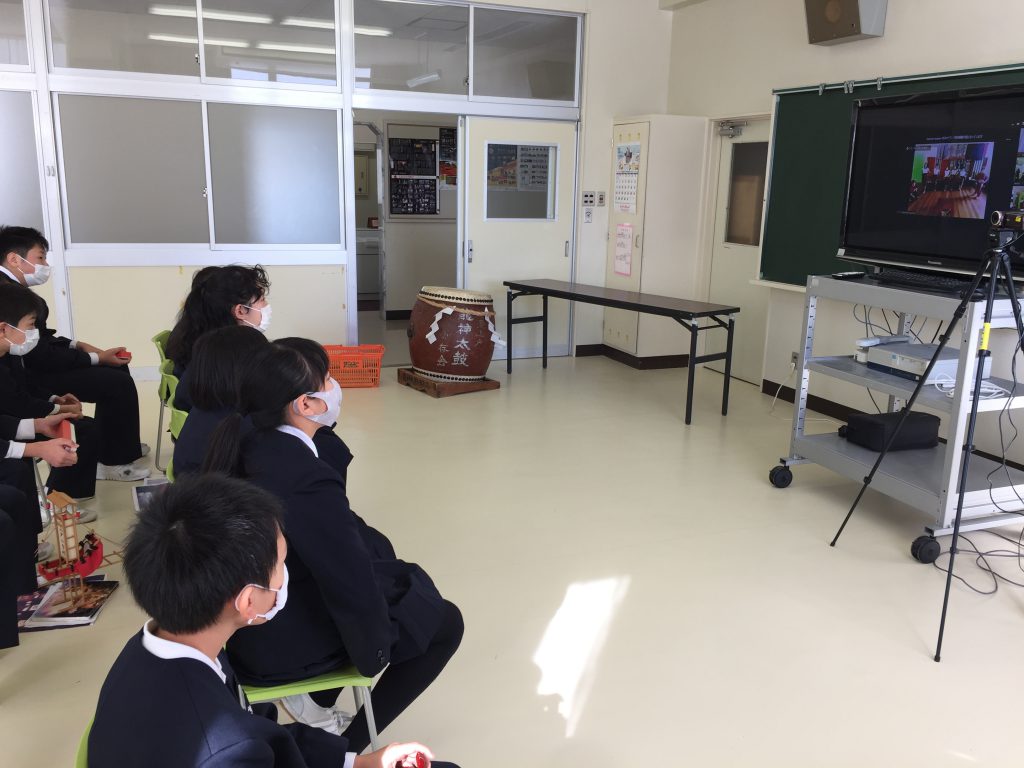
In the online exchange, Noto Uedo Elementary School pupils introduced Noto traditional culture. Firstly the “festival feast” was introduced. During festivals, feasts using regional and seasonal ingredients are prepared in order to invite guests to visit and have a feast, which differs depending on the house.
Next, kiriko lanterns used in Noto regional festivals were introduced. They light the path for the portable shrines during the parades. The festival in the Jike area of Suzu City takes place every September, in which gorgeous giant kiriko lanterns of height 16.5m (the largest in Japan) are used.
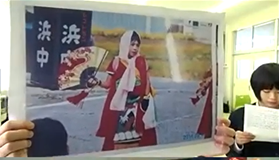
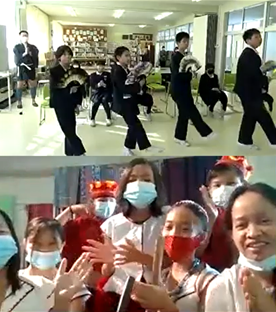
Lastly, the kyarage festival song was introduced. In the festival, boys wearing makeup and kimonos sing two kinds of songs using fans. Since they are the messengers of the God on the festival day, they cannot walk on the ground. Accordingly, the messengers are carried on people’s backs, and when they get off, they stand on a straw mat, not on the ground. They also ride on the floats. At the end of the programme, the students sang kyarage using fans. People of Ifugao listened to the pupils’ song and enjoyed the performance while clapping to the music.
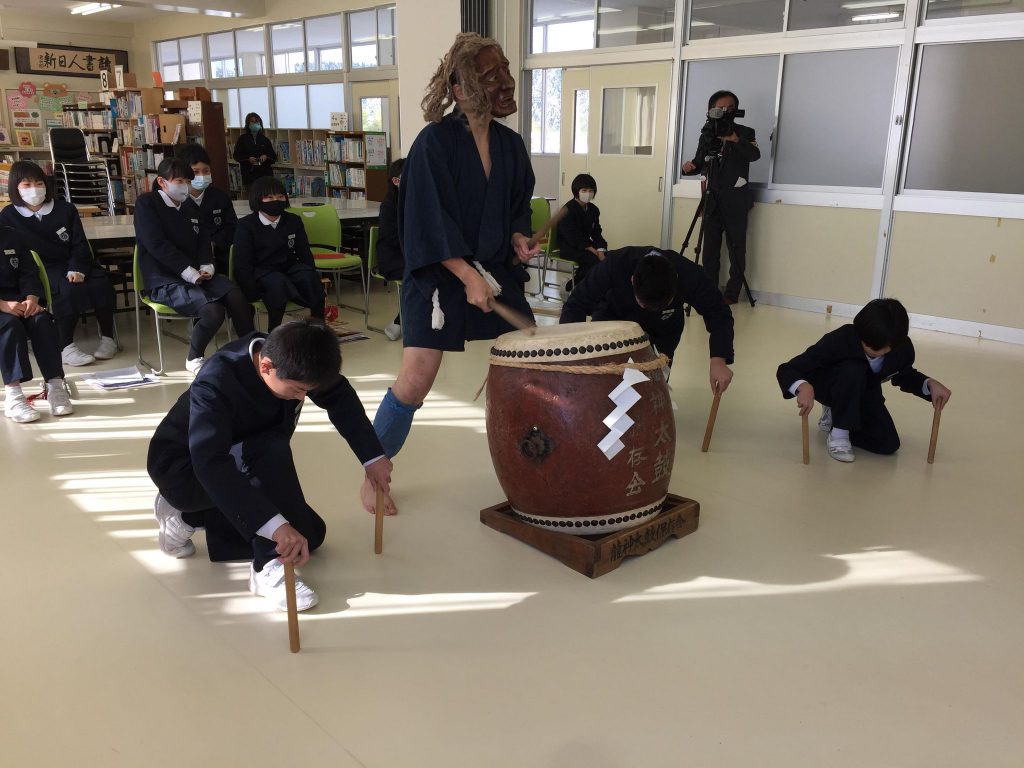
Japanese drums were also introduced. The father of a pupil who participated in the programme gave a detailed explanation about the Ryujin Drum. The Ryujin Drum story has been passed down for 1000 years. The story says that in those days in the Noto area, people suffered from poor crops due to devils’ behaviors. Ryujin, the dragon god, defeated the devils. The Ryujin drum performance conveys the story. The pupil and his father gave an impressive, powerful drum performance. There was an issue with the video call when the sound was interrupted due to the loudness of the drum. However, we presume that the impressive performance was understood by participants through the visuals also.
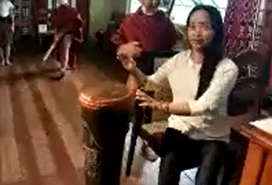
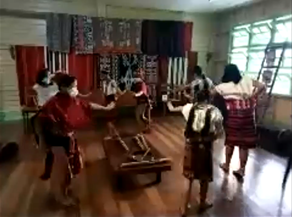
Next, Ifugao people gave a presentation about traditional song and dance. Firstly, a teacher introduced their drums. He said, “your drums and ours are very similar. We also play drums”.
Then, instruments which are indispensable for Ifugao traditional music were introduced, including a metal musical instrument called a “gum” and a bamboo musical instrument. Next, Ifugao traditional songs were introduced. Pupils from Uedo Elemental School listened to a performance in which Ifugao people wore traditional costumes and sang rhythmically while playing the bamboo instrument.
The participants exchanged not only their cultures but also many questions about weather and lifestyles with each other. As this was the final meeting of the programme, a commemorative photo was taken. The online exchange is over for now, but we will explore new ways of interacting, such as the exchange of postcards. We hope the connection between Noto and Ifugao children will continue into the future.
Noto/Ifugao International Exchange Programme #2 took place on November 26th. The report on Programme #1, as well as an explanation of the programme can be found here.
This time the theme was food culture and the differences between the foods of Ifugao, Philippines, and Noto, Japan. As advance preparation, videos showing how to make the rice-based sweets of each region were created and exchanged. Children from Ifugao explained how to make rice cakes, and children from Noto explained how to make rice crackers.
◆Ifugao rice cakes
A traditional snack made by boiling a mixture of powdered glutinous rice, sugar, coconut powder and water, and wrapping it in a banana peel
◆Noto rice crackers
A traditional snack made by spreading sliced rice cakes on a table so that both sides dry evenly, and then frying them in oil
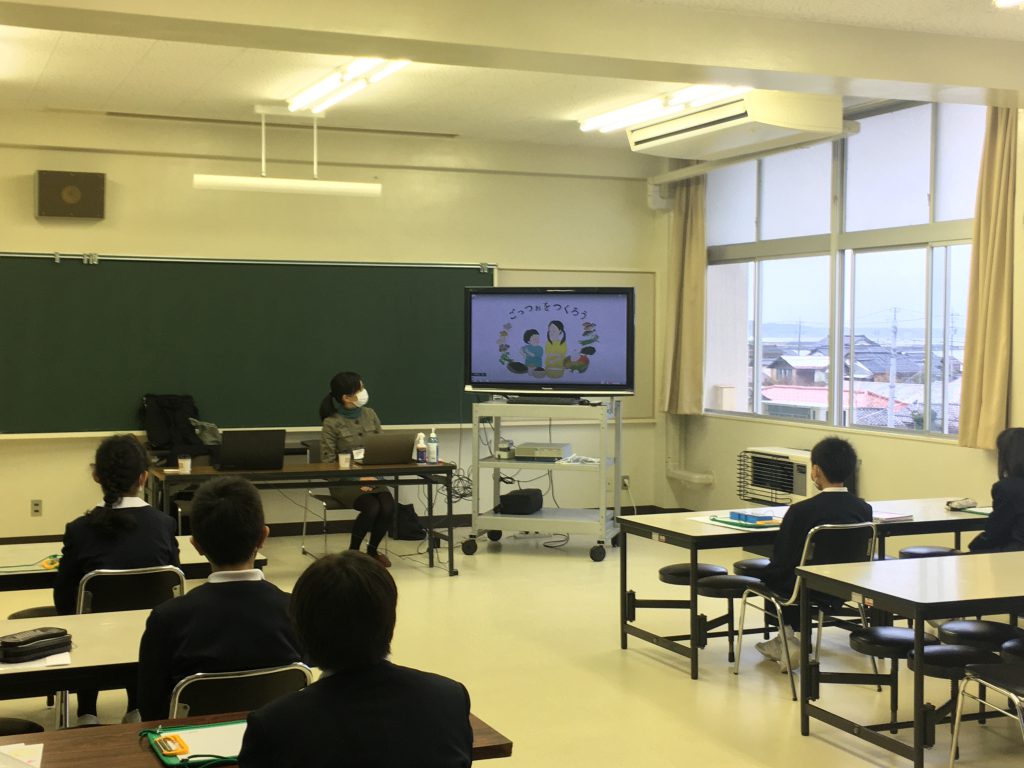
In addition to the videos created by both groups, participants watched a video about the link between the food culture, nature and agriculture of Noto entitled “Let’s Make Gottsuo (a feast)を” before the start of the programme. In Noto, the way of life that takes advantage of the blessings of Satoyama-Satoumi still exists, but there may be fewer opportunities to experience it in a home because of changes in lifestyle and family structure.
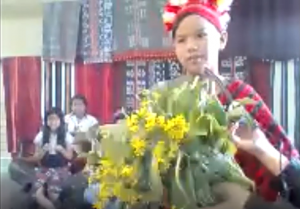
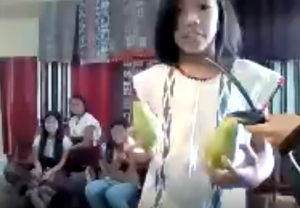
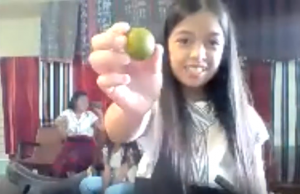
After the pre-programme activities, two schools were connected using an online meeting system, and the eagerly awaited second exchange programme began. First, students from Ifugao’s Kiangan Central Elementary School each presented a vegetable or a fruit harvested in Ifugao.
The produce included coconut, pechay, sayote and calamansi lime — food that one rarely sees in Japan. Comments such as “This contains a lot of vitamins, so it’s good for people’s health” and “I like it because it’s sweet and delicious” indicated that the children liked the food they presented and ate it often.
Next, children from Uedo Elementary School used panels to present the food of Suzu.
They began by presenting nigiri sushi, and oshizushi (pressed sushi), which is made for festivals and other celebrations, and vegetables grown in Suzu (daikon radish, Chinese cabbage, turnip, tomato, carrot, etc.). Next, they presented vegetables such as the distinctive regional Ohama soybeans, Okinawan spinach and Ebisu squash. Finally, they gave an explanation of dried persimmons, which are a major autumn product in Noto. This year, the Grade 1 and Grade 2 pupils of Uedo Elementary School dried 200 persimmons.
Everybody seemed to be very interested in the foods they were seeing for the first time. Even though Ifugao, Philippines and Noto, Japan are both located in Asia, they have different climates and cultures, so the fruit and vegetables that are harvested, as well as the cooking methods, are completely different.
The theme for the next programme, which will be the last, will be traditional culture. The main events will be presentations of regional festivals, which will include song and dance performances.
The book covers the unique properties of Japanese Gardens in Kanazawa city – and how they shape and are shaped by the society around them. Over 40 researchers, garden owners and other stakeholders were involved as authors in this booklet and their experience, knowledge, challenges and hopes are shared. It is also explaining the public sector’s policy and strategies for preserving the gardens and nature for the future.
Corresponding author and editor of this booklet is OUIK’s research associate Juan Pastor-Ivars and his community rooted garden preservation activities are introduced as models of sustainable urban nature preservation.
In the symposium, a presentation about Kanazawa’s traditional gardens and 2 talk sessions followed after Juan’s book introduction speech. More than 140 people participated to deepen their understanding of the importance of gardens, nature preservation and Kanazawa’s sustainable future throughout the sessions.
OUIK, which promotes educational projects concerning Noto’s Satoyama and Satoumi, which are designated as Globally Important Agricultural Heritage Systems (GIAHS), planned and implemented an online programme with Suzu City, Ishikawa Prefecture, to promote international exchange and learning of children from Suzu City and Ifugao, the Philippines during the Covid-19 crisis. Suzu City actively engages in SDGs implementation, as the city opened Noto SDGs lab in 2018 and launched an SDGs education programme for all of its elementary schools in 2020. The online programme was also part of Suzu City’s SDGs education programme.
The online programme was aimed at not only deepening the understanding of the local environment, SDGs and GIAHS but also at fostering the children’s communication capability and supporting their identity formulation by helping them learn about the differences between both regions in terms of culture and lifestyles, deepening their mutual understanding and having them explain their own cultures. OUIK prepared a three-day programme consisting of 1) an introduction of the region and self-introductions 2) an introduction of local food culture and 3) an introduction of local cultural activities. The first session was held on the 27th of October, and eleven students from Uedo Elementary School, Suzu City, and six students from Kiangan Central Elementary School, Ifugao, participated.
The day one session started with self-introductions from all of the students from both schools, followed by introductions of their respective regions. A Q&A session was organised at the end of the programme. Some of the students from Uedo Elementary School were a bit shy to express themselves, but it was good that all the students found some commonalities among them such as hobbies and interests even though they live in different regions and speak other languages. To explain about their own regions, students from Uedo Elementary School used many photos and pictures showing major tourist sites such as Kenrokuen Garden, the rice terraces in Wajima City, and rural festivals. Students from Kiangan Central Elementary School introduced their own rice terraces in Ifugao and the historical buildings and culture of their region. Funnily and heartwarmingly, students from Uedo Elementary School even introduced their formal school bag to make Ifugao students feel close. Finally, to show mutual respect and gratitude for the interaction, each school sang a song with their own language.
In the beginning, there were many children with nervous faces, but as they deepened their mutual understanding through the introductions, it seemed that everyone was motivated to know more and want to be known more. We are looking forward to holding the day two session.
This SDGs Café was organized as a continuation of the previous event’s theme of “What Education can be Expected Today?”—“Who are going to be the bearers of the year 2030?” This time, the Headmaster of Kanazawa University High School, Mr. Yamamoto, was invited to IMAGINE the future education in Kanazawa with regard to the year 2030. Before that, the 5 guidelines of the IMAGINE Kanazawa 2030 SDGs Project were presented.
The University High School is special in the sense that the Ministry of Education has appointed it as a pioneering worldwide model school for placing great importance on sustainability-related education. Furthermore, the school has a commitment to international exchange, and has received visits from various institutions and corporations on several occasions.
As was discussed in the previous SDGs Café, Japan’s schooling system needs to be reevaluated. The University High School places a great deal of importance on personal research and development alongside exam-oriented content, in hopes that the combination of both traditional education and a more personal and creativity-orientated education can result in a truly sustainable education system.
In order to pass on the value of the Globally Important Agricultural Heritage Sytems (GIAHS) of “Noto Satoyama Satoumi” and the local food culture to future generations, the Noto Region GIAHS Promotion Council and the United Nations University IAS-OUIK collaborated with local experts to create the picture book “Let’s Make a Harvest Feast” in 2018. This book offers an engaging way to learn about life in Noto, seasonal events, and food culture, making it interesting even for adults.
In 2019, an environmental education program themed around this picture book, called the “SDGs Mitsui Feast Project,” was conducted year-round at Mitsui Elementary School in Wajima City, Ishikawa Prefecture. Students harvested ingredients and learned about the local environment, traditions, and sustainable futures while creating their own “gottso” (feast).
To promote such educational activities more vigorously, OUIK has produced an animated version of the picture book this year. For the video production, specialists and locals helped to faithfully recreate sounds such as festival music, dialects, and bird calls. Additionally, with the completion of the English version, we plan to establish exchange activities between local elementary schools in Noto and the Ifugao Globally Important Agricultural Heritage Systems (GIAHS) (Ifugao Rice Terrace GIAHS) in the Philippines, utilizing this story to create international learning environments.
Japanese
English
We hope that this content will be enjoyed not only in educational settings such as schools but also at home.