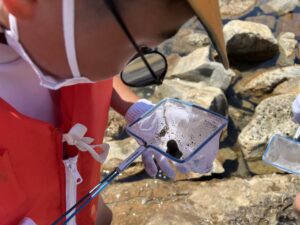
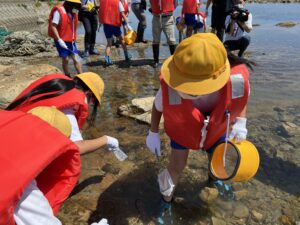
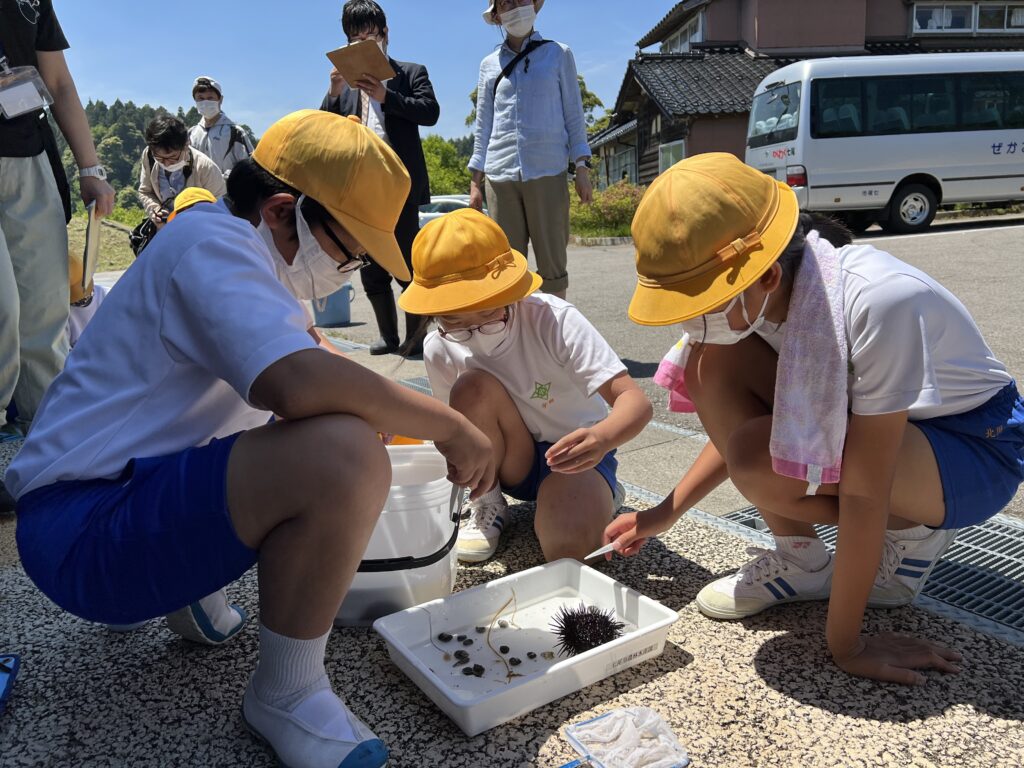
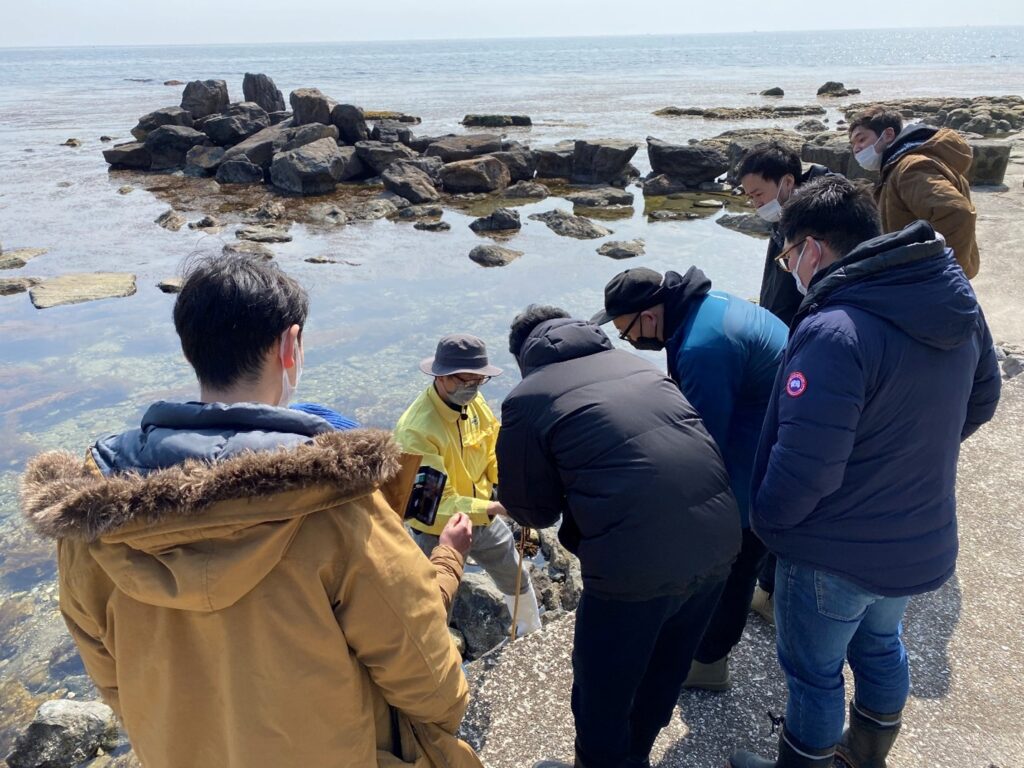
On May 24, 2022, we conducted a biodiversity survey of coastal creatures with fifth-grade students from Noto Island Elementary School at the rocky shore in Nagasaki Town. This initiative was organized in collaboration with the Noto GIAHS Biodiversity Working Group, supported by the United Nations University, and was prepared in conjunction with the City of Nanao. We invited Keiichi Sakai, an expert member from the Kanazawa University Marine Environment Research Center, as our instructor. Supporting us on-site were other working group members, Sayako Koyama (Researcher, UNU-IAS OUIK), Seiji Yanai (Ishikawa Prefectural University), Yasuko Kinoshita (Kanazawa University), and Nobuhide Gennai (Nagasaki in Noto Island). Additionally, Yoko Tomita (UNU-IAS OUIK) and Hideki Kobayashi (Kanazawa University) also assisted with the activities.
Initially, while listening to Mr. Sakai’s presentation, we reviewed our schedule for the day. When he asked the students, “Do you know any creatures you can find in the coastal area?” the children mentioned various creatures like “sea bream” and “fugu.” Mr. Sakai explained, “The coastline we are going to has many different creatures. Instead of collecting many of the same type, let’s aim to collect and observe as many different types as possible.”
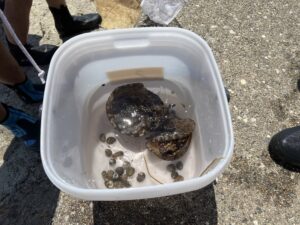
Everyone changed into marine boots, took buckets for collecting creatures, and moved to the coast. The observation of living creatures began in the shallow rocky areas. The students discovered various creatures, noting that what appeared to be small stones up close were actually shells, and when using the collection box, they saw many small shrimp and fish swimming around. Some exclaimed, “There are a lot of fish, but they are too fast to catch,” and “There are shells, but they are stuck to the rocks and I can’t get them.” Despite their struggles, they worked together in groups to collect as many different species as possible for later identification.
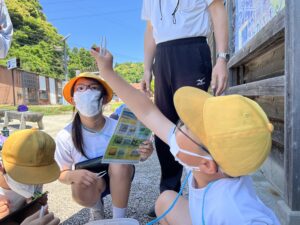
After gathering a lot of creatures into their buckets, it was time for species identification. While listening to the instructor, the students grouped the same types of creatures on a tray. Looking at a reference sheet of coastal living creatures created by the working group, they observed and noted, “This shell looks similar but is slightly different,” and “Is this a hermit crab?” The instructor also provided explanations such as, “The shell with a pattern like a stone pavement is called Ishidatami,” and “The long and numerous shells are a type of Uminina.” The students were especially intrigued by a small and squishy creature called a white sea slug (Shiro-umiumi), which they found rare. They were surprised to learn, “This cute little white sea slug is about 3 to 4 cm, and this is generally the size of an adult.”
Finally, the students experienced name searching and information submission using a smartphone app called Biome, identifying types like “Purple Sea Urchin (Heliocidaris crassispina)” and “Brittle Star (Ophiuroidea).”
The United Nations University supports educational activities aimed at a sustainable future utilizing the Globally Important Agricultural Heritage Systems “Noto Satoyama Satoumi.” Engaging with and observing familiar creatures, as well as listening to local residents, is seen as a first step in passing on Noto’s nature, traditions, and culture to the next generation. Through this biodiversity survey, we hope the students will gain greater interest in their local area and continue to deepen their understanding through various activities in the future.
The 10th networking event for IMAGINE KANAZAWA 2030 Partners was held on March 25, 2022. The final networking event of the 2022 fiscal year was held at a venue for the first time in a while, as COVID-19 had calmed down. During this event, the following organizations gave pitch presentations:
Cominguru Co., Ltd.
The role of the hospitality industry in contributing to sustainable community development
Kao Group Customer Marketing Co., Ltd. presented for the second time at this event. The Kao Group continues to produce a variety of products, including consumer products for everyday life and a chemical business aimed at the industrial sector. They have positioned the Kirei Lifestyle Plan as part of their ENvironmental, Social and Governance (ESG) strategy and have established a Social Communication Division. The company actively engages in communication with diverse communities and conducts social contribution activities focused on environmental issues, health, hygiene, and diversity. They aim to contribute from the perspectives of consumers and are committed to responding to the desire for and actions toward a sustainable lifestyle through awareness workshops.
Cominguru Co., Ltd. operates 24 lodging facilities in the Kanazawa city’s old town area under the “Tabine” project, aiming to create a Kanazawa where families want to live even 100 years into the future. They view “Tabine” as a project to create opportunities for travelers and the city of Kanazawa, with the goal of fostering Kanazawa fans around the world. Utilizing historical wooden structures known as “machiya” as lodging facilities, they also contribute to the preservation of the landscape of Kanazawa City, with plans to increase the number of machiya properties they operate.
Furthermore, they are considering initiatives that do not burden the natural environment, especially in terms of amenity materials, equipment, and waste handling, while maintaining a high-quality experience for guests and ensuring their satisfaction.
In the 2021 fiscal year, IMAGINE KANAZAWA 2030 Partners held a total of 8 networking events, with 22 organizations presenting and 243 participants attending. Through dialogue among participants at these events, connections are forged, challenges are addressed, and open innovation contributes to the achievement of the SDGs. Organizations that participated in the networking events have connected with each other, leading to the initiation of several projects.
The Partners Networking Events are set to power up further in the 2022 fiscal year. Organizations facing challenges, those working on social issues in the community, and those looking to expand their business and form networks are warmly encouraged to participate.
On 16th December, designated as World Food Day by the United Nations, to commemorate the release of the animation titled “Let’s Make a Harvest Feast!”—based on a picture book with the same title which explores the close relationship between the local food culture, nature, and agriculture in Noto—OUIK held a webinar to discuss issues surrounding food around the world and Japan, and reflect on the relationship between food and the livelihoods of the local people in the Satoyama and Satoumi of Noto, a Globally Important Agricultural Heritage Systems (GIAHS) site, and its potential as a place for children to learn.
Originally, the picture book was prepared in 2018 as a guidebook to convey the value of the Noto GIAHS, which comes from a complex relationship between various elements spreading across nine different municipalities, to local children and citizens. The Noto Regional Association for GIAHS Promotion and Cooperation and OUIK worked together to convey the richness and the attractiveness of the local agriculture, nature, and culture to children from the viewpoint of food. This year, to disseminate the value of Noto GIAHS to a larger number of people around the world, an animation was made based on the picture book.
Ms. Akiko Koyama, a Research Associate at OUIK, explained that hopefully, the webinar gave an opportunity to reconsider the value of Noto GIAHS, after reflecting on the situation that more and more people recognise the importance of the transmission of traditional knowledge and diversified production, as the Noto region demonstrates, to the biocultural diversity and food problems of the world.
The webinar consisted of three sessions. The first session was a lecture from Ms. Kae Mihara, Liaison Officer in Japan at the Food and Agriculture Organization of the United Nations (FAO), titled “Issues surrounding foods in Japan and the world”. The second session was a case introduction from Ms. Yuki Hagino, of the Maruyama-gumi group, about the SDGs Mii’s Feast Project, a programme to implement “Let’s Make a Harvest Feast!” at a local school, Mii Elementary School in Wajima. The final session was a panel discussion titled “Creation of the animation ‘Let’s Make a Harvest Feast!’ and the possible educational activities at Satoyama and Satoumi”, inviting six experts and creators who cooperated to produce the video.
Issues surrounding foods in Japan and the world, Ms. Kae Mihara, Liaison Officer in Japan, FAO.
Ms. Mihara represented FAO and explained urgent issues surrounding sustainable agriculture and food security in Japan and around the world. Although the world’s food crisis was thought to be caused by the food production crisis approximately 75 years ago when FAO was founded, Ms. Mihara explained, the situation has become more complicated. A more comprehensive view is now required due to recent concerns about the environment and sustainability in the past few decades.
The existing concerns are various and intricately intertwined. Conflicts, climate change and economic recessions have caused a rise in the number of people in hunger, which had been decreasing until 2014. The balance in the agriculture and food systems has been lost, while obesity, damage to the environment, and food loss and waste have emerged. The impact of Covid-19 is threatening the life security of people in food supply chains. The food supply system in Japan, which depends heavily on imports, must transform its methods of production, distribution, and consumption, and establish a sustainable food supply chain for the food security of people in Japan. The concept of local production and consumption is becoming more crucial in the face of the Covid-19 crisis.
Ms. Mihara also emphasised the contribution of GIAHS to local food security and livelihoods in rural areas. GIAHS, which FAO launched in 2002, is a programme to encourage the designation and conservation of globally remarkable agricultural production systems to be inherited by future generations and to adapt to the change of environment for regional development. Notably, GIAHS regions have formulated and maintained sustainable agriculture production systems for ages, and contribute significantly to food security and livelihoods in rural areas. Ms. Mihara expressed her hopes that the Noto GIAHS, one of the first regions in Japan to be designated as a GIAHS, will continue the current activities in Satoyama and Satoumi in Noto, and convey its remarkable value to the world and contribute to international cooperation through hosting study tours.
Case introduction: SDGs Mii’s Feast Project, Ms. Yuki Hagino, Maruyama-gumi.
Ms. Hagino, an advisor for the project to prepare the picture book, “Let’s Make a Harvest Feast!”, talked about her experience at a local elementary school to use the book as an educational tool.
Ms. Hagino is an activist who implements the concept of the Noto GIAHS in the Noto region. One of her activities is to provide a place of learning firmly rooted in the local region. Welcoming a lot of participants with various backgrounds, Ms. Hagino conducted monitoring surveys on the local flora. Along with the participants, she also collected and shared indigenous knowledge in the lives and traditional agricultural methods and festivals of the local people.
In 2019, she held a series of classes and a field trip at a local elementary school, Mii Elementary School in Wajima, by using the picture book, “Let’s Make a Harvest Feast!” and issued a report titled “Annual Report for SDGs Mii’s Feast Project”, which summarises the activities in the classrooms. She perceives that, in the traditional lifestyles of the local communities, food is not only associated with eating, but also an entire cycle of actions related to food including seeding, cultivating, mowing, boiling, and dedicating foods to deities. However, such a unique understanding of food rooted in local lives disappears as biodiversity is threatened around the world. Thus, she decided to implement the Feast Project with school children to record local things associated with food to pass them on to future generations.
The first lesson in May started with reading the picture book, “Let’s Make a Harvest Feast!” so that children could first learn about the annual cycle of the harvest feast, the local cuisines, the associated local lifestyles, and their seasonality. This provided the children with the necessary background knowledge to understand the significance of their field trips. After experiencing and learning about the bounty of nature from local people in the fields, in the end in December, the children participated in the local agricultural ritual called Aenokoto and devoted ritual cuisines, for which the children collected the ingredients through the year, to deities of the rice fields. Ms. Hagino recommended the picture book, saying that it is an effective tool for teaching elementary school children of all ages about the local region.
Panel discussion: Creation of the video “Let’s Make a Harvest Feast!” and the possible educational activities at Satoyama and Satoumi
Lastly, a panel discussion was held moderated by Ms. Koyama, where six experts and creators gathered to discuss education in and about Satoyama and Satoumi. The members were Mr. Koji Ito, of the Gifu University Center for Collaborative Study with Community, Mr. Tomoya Kishikoka, of the Kanazawa University Frontier Science and Social Co-Creation Initiative, Ms. Yukiko Matsumura, an illustrator, Mr. Calum Galt, of Polygon Pictures Inc., Ms. Mayumi Nakamura of the Ishikawa School of Nature, and Ms. Hagino.
The panel pointed out three takeaways as the conclusion of the dialogue. Firstly, the produced animation is a charming tool to convey Noto’s GIAHS-designated Satoyama and Satoumi regions. GIAHS doesn’t certify the assemblage of single elements, but rather the connections of various components in the area, including agriculture, culture, and biodiversity. The original picture book conveys the links in an easily understandable and attractive manner. Secondly, it’s important to see the richness of Satoyama and Satoumi as things intimately connected to ourselves. Thirdly, it’s essential to have common goals among the various stakeholders concerned. One of the problems in the Noto region is that activities to pass on the living wisdom of Satoyama and Satoumi to children are ceasing due to the change in the family structure. Thus, educational institutions are vital to bridge people who know the wisdom and school children, gaining support from the public and private sectors.
Finally, at the end of the webinar, Mr. Tsunao Watanabe, Director of OUIK, highlighted the importance of reviewing and learning the inherited wisdom which has leveraged the resources in Satoyama and Satoumi as well as the harvest feast together with children to conserve, use, and pass on the Satoyama and Satoumi to future generations and promote local production and consumption.
In Kanazawa City, a comprehensive vision known as the Kanazawa Future Scenario has been developed through the collection of ideas from many individuals aimed at promoting the SDGs. To put this vision into practice, the IMAGINE KANAZAWA 2030 Partners Exchange Meeting was held in January and February, where participants brought forward their challenges and initiatives in hopes of fostering new projects through dialogue.
This year marks the seventh meeting, and in total, it was the ninth gathering. Due to the impact of COVID-19, the meetings were held online, but we hope to return to in-person events once the trend of infection subsides, allowing ideas to flourish.
During Exchange Meeting #8 & #9, the following organizations delivered pitch presentations:
Exchange Meeting #8 Presenting Organizations (held on 2022/1/27)
PADAYON, General Incorporated Association
Discussed projects aimed at simultaneously addressing issues in developing countries and local community challenges.
E.N.N. Co., Ltd.
Focused on countermeasures for vacant houses and vacant buildings.
Exchange Meeting #9 Presenting Organization (held on 2022/0226)
Visst Co., Ltd.
Discussed employment support for those in need.
Additionally, the Exchange Meeting #9 reflected on activities from the past year and engaged in discussions on how to further develop the gatherings.
At this event, we had the opportunity to hear in-depth about the unique and pioneering initiatives from each organization, fostering connections that could lead to new partnerships and projects.
Each organization shared details about their activities and the challenges they are facing:
PADAYON, General Incorporated Association is a social startup engaged in addressing social issues in both Japan and the Philippines through impact investing, a method of social investment. The name “Padayon” means “Let’s do it together” in the local language of the Philippines, emphasizing the importance of enjoying the process of community and people building together.
Through connections with families from the Philippines, they encountered employment issues faced by the middle generation struggling to find work. As a result, they aimed to create an ecosystem of social investment that contributes to Kanazawa while providing a platform for Filipinos to utilize their skills. They have formed partnerships with companies in Kanazawa that want to contribute to the SDGs, expand overseas sales channels, and address labor shortages. They are running an impact investment project to provide rental spaces for small businesses in the Philippines and offer job opportunities and learning experiences for locals. This is just one example, as the actual matching process between companies in Kanazawa and those in the Philippines is handled on an individual consultation basis. They also conduct donation projects to directly support food supplies to the Philippines.
E.N.N. Co., Ltd. operates as a social design company that centers on architecture and aims to help find, plan, create, and effectively utilize spaces to build “towns and cities.” With the increasing number of vacant houses and buildings in Kanazawa, they sought to bring awareness to these social issues and presented their initiative.
Compared to Western countries, Japan has a significantly advantageous new housing market, with around one million new homes built each year. However, with the population remaining stagnant, the number of vacant houses and buildings continues to increase. In Kanazawa City, efforts are underway to preserve and utilize wooden buildings such as Kanazawa Townhouses, which were built before 1950. Unfortunately, these buildings are slowly being demolished, leading to an increase in vacancies and the deterioration of the townscape, along with concerns about carbon dioxide emissions from building dismantlement. To address these problems, E.N.N. Co., Ltd. offers investigative services through their “Old Building Research Room” and “Wooden Building Research Room” to assess nearby used buildings and wooden structures.
At the conclusion of Exchange Meeting #8, Hokuriku ESD Promotion Consortium was introduced. Established in 2014 with Kanazawa University as the secretariat, this consortium aims to promote Education for Sustainable Development (ESD) to achieve the SDGs. They shared information about the outdoor educational activities for children in hospital classes at Kanazawa University Hospital.
Many of the children in hospital classes require long-term hospitalization and, because of infection control, many cannot go outside. As a result, they find it challenging to learn through outdoor activities like nature observation. However, due to advancements in filming and communication equipment, it has become possible to enjoy stargazing remotely. Therefore, in 2021, the Hokuriku ESD Promotion Consortium collaborated with the Kanazawa City Kigo Mountain Fureai Training Center and the Kanaboshi-kai (astronomy club) to conduct multiple online stargazing sessions that children could enjoy from inside the hospital. Going forward, they would like to expand these activities beyond stargazing to include museum visits, social observations, and more, tailored to the children’s needs.
In Exchange Meeting #9, Visst Co., Ltd. spoke about their management philosophy of providing hope for work to everyone, particularly focusing on employment support for individuals with disabilities or others who may face challenges in the job market. During the pitch presentation, they shared their initiatives and challenges related to employment support for those in need. Visst Co., Ltd. has been facilitating the “Employment Preparation Support Project for Welfare Recipients and Individuals in Need” commissioned by Kanazawa City, encouraging participation in everyday, social, and work contexts for “welfare recipients” and “individuals in need.” In Kanazawa City, there are about 4,000 welfare recipients and nearly ten times that number of individuals in need, a situation exacerbated by the impacts of COVID-19.
As part of their support, Visst Co., Ltd. helps improve interpersonal skills and self-esteem through work experiences and volunteer opportunities, aimed at ensuring individuals can live independently in society. However, securing organizations willing to cooperate as host sites can sometimes be challenging. During volunteer activities, staff from Visst Co., Ltd. accompany participants to ensure smooth operations and are actively seeking organizations to collaborate with.
Both Exchange Meetings #8 and #9 showcased diverse challenges from various organizations. It was a valuable opportunity to learn about the situation in Kanazawa City, and the discussions sparked new ideas and exchanges. I hope that the IMAGINE KANAZAWA 2030 Partners Exchange Meeting continues to expand partnerships and gives rise to new projects.
As I will be completing my nine-and-half year term with the UNU-IAS at the end of this month, I would like to take the opportunity to express my gratitude to all friends, colleagues and residents of Ishikawa Prefecture for making my research journey in Noto such a rewarding experience of lifetime.
I recall my first visit to the Noto Peninsula. It was the summer of 2011, and “Noto’s Satoyama and Satoumi” was just designated as one of Japan’s first Globally Important Agricultural Heritage Systems (GIAHS). I was serving an internship with UNU-IAS OUK then, taking my summer holidays off from my master’s studies at the University of Tokyo. I was intrigued by the proximity of satoyama and satoumi, and enchanted by its rustic scenery, fascinating architecture, and beautiful crafts. Needless to say, the great food and warm hospitality also instantly captured my heart.
Never did I imagine at that time that I would have the honor and opportunity to make Noto my research field. After my graduation, I joined the UNU-IAS Tokyo office in 2012 to work with the research team to promote GIAHS in Japan and have technically assisted with the applications of every Japan GIAHS designation ever since. Building on my experience working with GIAHS in Japan and overseas, from 2013, I also started working closely with our UNU-IAS OUIK colleagues in Kanazawa to find policy research relevant and contributes to the lives and livelihoods of the people in Noto. Residing and based in Tokyo, I have to be honest that I was not sure what I could do for Noto, or if my understanding of Noto would be superficial. But on every opportunity of my visit to Noto, I made my best effort to learn, remembering every sight I saw and every story shared with me. I drove around Noto sometimes, but I also took the local buses to navigate around just to remember places and their names. Every step of my research journey here, farmers, fishers, ryokan owners, residents and Noto people from all walks of life have been so generous to share their candid views and imparted their knowledge to a foreign researcher like myself.
Touched by their kindness and impressed with what I have learned, I wanted more people to know about this rich knowledge and stories of Noto. I then initiated the OUIK’s “Noto Satoumi Movement” in 2015 because many people in Noto have told me that while more efforts to conserve satoyama have increased after the GIAHS designation of “Noto’s Satoyama and Satoumi”, most people did not know how they can contribute to conserving satoumi. A series of “Noto Satoumi Seminar” was conducted in Nanao city, Anamizu town, Suzu city, Noto town, Hakui city and Wajima city from 2015 to 2017, exploring a range of themes relating to Satoumi with national experts and local stakeholders. We explored topics from seaweed, traditional fisheries, shellfish, satokawa, blue tourism to ama women diver. Yet, these seminars just barely touched the surface and have yet to unravel the richness and diversity of Noto’s remarkable satoumi.
From 2018 the Movement focused on outreach efforts beyond Ishikawa Prefecture and Japan. From 2020 to 2021, despite the COVID-19 pandemic, a new series of Noto Satoumi Webinars exploring the linkages between Noto’s satoumi and SDG 14 “Life below water” was organized. I genuinely thank all experts, speakers, and stakeholders who had helped us with this Movement. I am proud to say that now many researchers in Japan and overseas are starting to relate “satoumi” with the Noto region, and I hope this interest continues to thrive.
Researchers like me will have nothing to tell if no one shares their knowledge and experience with us. I am truly grateful to be blessed with the kindness I received over the years in Noto and Ishikawa Prefecture. Thank you for allowing me to contribute to your GIAHS even as a foreigner residing outside Ishikawa Prefecture. Noto will always have a very special place in my heart and will always be a lifetime supporter of Noto’s GIAHS. Thank you for letting me experience the true meaning of “能登はやさしや土までも”. I thank you from the bottom of my heart.
Sustainable Development Goal 7 is to “ensure access to affordable, reliable, sustainable and modern energy for all”. Although we nominally understand that it is good to choose renewable energy, instead of energy derived from fossil fuel, it might be challenging to take concrete actions to realise it.
Against this backdrop, at the 14th SDGs Café we discussed local production and consumption of energy in the Hokuriku region. We invited two experts, Mr. Shinichiro Nagahara and Mr. Akira Taniguchi. Mr. Nagahara is from Kanazawa Civil Power Stations, an organisation that operates solar power stations and a wind power station invested in by groups of citizens in Ishikawa. Mr. Akira Taniguchi is from Ohisama Shinpo Energy, a company that promotes renewable energy and energy-saving business. They introduced the good practices of citizen-owned power plants in Japan.
This SDGs Café consisted of four sessions. First, Ms. Mikiko Nagai, Office Manager of OUIK, gave an opening greeting and introduction to the webinar. Secondly, Mr. Nagahara gave a presentation, titled “Achieving sustainable society through the power of citizens! The case of Kanazawa Civil Power Stations”, introducing the activities of his organisation. Thirdly, Mr. Taniguchi gave a presentation, titled “Local production and consumption through renewable energy to enrich communities”, introducing examples of the renewable energy sector’s efforts in Japan, specifically the Hokuriku region, and Germany, as well as the case of Iida City, Nagano Prefecture. Finally, a panel discussion was held with Ms. Nagai and the two experts to discuss the business models of citizen-owned power plants, their equipment, and their policies. The panel also made comments on the system of renewable energy service delivery in Kanazawa city.
Mr. Nagahara defines the civil power station as a system in which individual citizens and local communities invest, build, and operate renewable energy projects by themselves to achieve local production and consumption of energy in the region. The idea was widespread in Japan in 2012 when the law for the feed-in-tariff was brought into effect in Japan.
After visiting Denmark in 2005 to learn about their wind power plant systems, more than 80 per cent of which are owned by local co-operatives, Mr. Nagahara decided to start a project to construct a wind power plant in Ishikawa. The investment from citizens covered around 300 million of the 500 million Japanese yen needed for its construction costs. Through his experiences with the project, he recognised that the citizens’ consciousness is essential to proceed with environmentally friendly city development.
Since then, he has developed some renewable energy plants in Ishikawa, from solar power energy plants to a woody biomass power plant. Mr. Nagahara hopes that Kanazawa will become an environmentally friendly city resilient to disasters thanks to the spread of zero-energy houses by 2030. A zero-energy house is a housing energy system where the produced energy becomes higher than the primary energy consumption by combining energy saving, renewable energy production, and energy storage, contributing to greenhouse gas reduction. Mr. Nagahara concluded that the primary purpose of his addressing environmental problems is to contribute to the prevention of global warming, and that zero-energy houses are reasonable solutions to it.
Mr. Taniguchi said that Japan should produce more biomass energy, as it is rich in biomass, referring to the example of Sweden, where a company supplies heat by delivering hot water derived from biomass fuel. Also, referring to the case of Germany, where individuals and farmers’ investments occupy almost 60 percent of the total installed capacity in renewable energy, Mr. Taniguchi claimed that citizens’ participation is essential to spread renewable energy. He also mentioned that notably, commercial motivation encourages citizens to invest.
Mr. Taniguchi also introduced the case of the citizen-owned power plant in Iida City, where a company procures and installs solar power panels using a fund financed by citizens from all over Japan. The company sells the produced power directly to the facilities with the installed solar panels. The fund was paid off in 15 years. The project was made possible due to the longer term and the exceptional purchase price in the power purchase agreement shrewdly decided by the Iida City administration. Another benefit is that the solar power projects contribute to revitalising the regional economy, as research forecasts that the potential accumulation of economic value added to the region through the project will reach 1.7 billion Japanese yen by 2030. Mr. Taniguchi emphasised that the most crucial step was to produce energy helpful for the region by themselves with the support of the municipal government and local regulations.
Finally, a panel discussion was held with Ms. Nagai, Mr. Nagahara and Mr. Taniguchi to discuss the issues related to local production and consumption of energy. The panel raised several interesting points as discussion topics.
Concerning the conflict of interest between citizen-owned power plants and large electricity companies, one of the answers was that the relationship is not like competitors, but rather like business partners when citizen-owned power plants sell a small amount of electricity. To the question of how large electricity companies’ business models will change when zero-energy houses are widespread, large electricity companies can still keep seven-tenths of the electricity market as the electricity for industrial use occupies around 70 percent.
Also, obstacles to proceeding with policies to allow installing solar panels on roofs of public facilities were discussed. Such policies have not yet been promoted in Ishikawa Prefecture and Kanazawa City, while Iida City has already advanced such policies. It is uncommon for public facilities to lease their roofs for solar power to electricity providers in some municipalities, and even in cases where the installation of panels is allowed, with the initial cost being double the ordinary price, it becomes a burden to the municipalities. As such, it is crucial to develop a partnership model with the private sector.
Lastly, the panel discussed Kanazawa City’s decision to request a private company to operate a hydropower plant and a gas power plant owned by the city, as the hydropower plant operates financially healthily while the gas power plant struggles. The panel pointed out that the hydropower plant should be operated over a long period without being bound by immediate profits, as citizens of Kanazawa City might be proud of its existence in the city. Also, the importance of the philosophy of the operation and the sustainability of operating organisations was pointed out.
On March 10th, a study session focusing on the satoumi (coastal sea) was held at the Noto Marine Center, featuring six chefs from the NOTOFUE organization, who are active in Ishikawa Prefecture. The UNU-IAS OUIK also provided coordinating support for the event.
The session began with a presentation by Keiichi Sakai (Researcher, Kanazawa University’s Institute of Natural and Environmental Technology), who discussed the characteristics of Noto’s satoumi and the history of utilizing marine products. Given that the chefs are dedicated to exploring the ingredients from Noto’s satoumi, a passionate discussion followed the lecture, leading to many questions such as, “What are the impacts of global warming?” and “What can we do?” The engaging discussions continued, and it was decided to organize similar events in the future, marking the end of the first half of the lecture.
Satoumi lecture
In the second half, participants went outdoors, where Yuma Higashide (Noto Marine Center) provided insights about marine life along the shore. While observing various coastal creatures, attendees had the chance to touch them and even taste some edible seaweed. There were enthusiastic reactions like, “This is delicious!” indicating many new discoveries. The beautiful weather provided warm sunshine, allowing for a fulfilling observation session.
Chefs listening intently to the explanation about seaweed
Looking ahead, it will be exciting to see what initiatives will emerge from this event.
The e-learning material “2021 Regional Food and Culture Connected Overseas Exchange!” (Part 1 and Part 2), developed primarily by Researcher Koyama, was released on the Hokuriku ESD Consortium’s YouTube channel on March 10.
This material introduces the educational initiatives related to the Globally Important Agricultural Heritage Systems (GIAHS) that the UNU-IAS OUIK has been working on in Noto (Part 1), as well as online exchanges between children from the GIAHS regions of Noto and Ifugao, conducted in collaboration with the Noto SDGs Lab and the GIAHS Center at the National Ifugao University (Part 2).
We hope this will be a useful reference for teachers interested in SDGs learning and overseas exchanges that utilize local characteristics, as well as for those involved in children’s educational activities. Please take a look!
At many UN meetings on the matter, it has been said that local municipalities have a vital role to play in achieving the SDGs, to the point that of the 169 targets of the SDGs, 65% are estimated to be difficult to achieve without the participation of local municipalities. At this webinar, we discussed what kinds of initiatives should be undertaken at a municipal level in order to encourage transparency in municipal administration and cooperation and participation from citizens regarding setting and monitoring indicators for the SDGs.
First, representing Kanazawa City, the event’s co-sponsor, Yukiyoshi Yamano (Mayor of Kanazawa City) gave an opening speech. “In terms of governance, I think even simple daily tasks will effectively contribute to the achievement of the SDGs. In order to maintain motivation, I think it is important to create an environment in which it is easy to see the progress made towards our targets. Each municipality needs to have achievement targets and monitoring systems that are appropriate for them, and which are publicized in a way that allows citizens and partners to see the progress made as well. It is vital to maintain mutual understanding as we advance our efforts,” Yamano opined.
The first keynote lecture was given by sustainability and regional revitalization researcher Shun Kawakubo (Associate Professor, Hosei University, Faculty of Engineering and Design, Department of Architecture) on the topic of “Local SDGs Promotion and the Significance of Target-Based Monitoring.”
To support local municipalities, Kawakubo is developing a local SDGs platform in order to make the status of local SDGs initiatives more visible. The platform also includes interview articles from the municipalities and ways to share and announce new initiatives. While he encouraged the municipalities to utilize the platform, he also emphasized how vital it is to proactively involve the citizens when establishing SDGs indicators that reflect the current status of progress made, saying, “It’s important for citizens to have the awareness that the SDGs are an issue close to their hometown, and to encourage them to incorporate working towards the goals in their everyday lives.”
The second keynote lecture was given by Kenichiro Fukushima (Board Representative, Code for Kanazawa/Civic Tech Japan) on the topic of “Citizen Participation Through Technology: What is Open Governance?”, in which he discussed using open governance and civic technology to implement local SDGs, monitor indicators, and encourage citizen participation.
Fukushima explained that because it is best to have citizens participate in the process of monitoring and gathering indicator data, it is vital to have transparency in government work and create a society that allows citizens to participate; in other words, it is important to create a framework of open governance. He went on to say, “Municipalities must consider to what extent they are able to utilize technology within the scope of their limitations, and to keep an open mind as they encourage citizens’ participation. It is also important that the citizens understand and proactively promote use of the IT and other technological aspects of the initiatives, participate in the community, and cooperate with government efforts. It’s important that both sides continue to share their mindset with each other.”
Next, Masayuki Yamamoto (Head of Policy Promotion Division, Policy Strategy Department of Kaga City) introduced Kaga City’s smart SDGs initiative. Kaga is a city known for its traditional crafts, famous hot spring resorts, and tourist spots, but it is also a city faced with structural issues such as a lack of human resources as a result of depopulation, and a decentralized, multipolar city structure. As such, they are aiming to become a smart city by using advanced technology to promote innovation and become a more sustainable city. As part of their initiatives to work towards becoming a smart city, they are considering incorporating a variety of technological tools and systems as solutions to everyday problems, including drones, MaaS, avatars, and e-residency. Additionally, as part of their “Kaga City RE100 (100% Renewable Energy)” initiative, they are aiming to construct a carbon-free society and locally produce energy for local use.
Finally, UNU-OUIK Office Manager Nagai moderated a panel discussion in which a variety of ideas and opinions were expressed, including the following:
o It is important for governments to explain the various functions of the SDGs when cooperating with citizens and to utilize them together
o It is important for the divisions in charge within government bodies to coordinate and gather resources
o Local SDGs platforms might be used to exchange information and opinions
o Measuring, monitoring, and analysis of indicators might be split up between governments, academics, and the citizenry
o It might be good to promote the SDGs through fields that go beyond the scope of existing SDGs (culture, art, sports etc.)
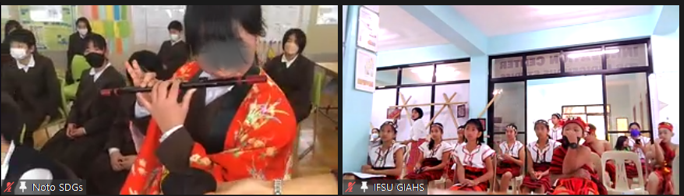
The United Nations University UNU-IAS OUIK, Noto SDGs Lab., and Ifugao State University GIAHS Center are collaborating to promote exchanges between children in the Noto and Ifugao, both are designated as the Globally Important Agricultural Heritage Systems (GIAHS) by the Food and Agriculture Organization (FAO) of the United Nations. The third elementary school exchange in FY 2021 was held online in February 2022. This exchange focused on the introduction of local dances and drums.
First, a video of students from Shoin Elementary School playing traditional festival music using instruments such as drums and flutes was shown, followed by an introduction of the costumes worn at the festival and a demonstration of the flute. They explained that the sound of the drums represents rain and the music is played to pray for rain. They also showed that there is a bell on the hem of the costume and explained that on the day of the festival, the sound of the bell can be heard throughout the town.
お祭りの横笛を紹介している様子 A student performing the flute
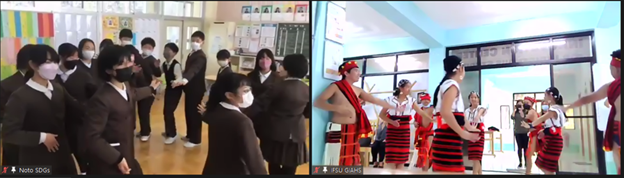
Students from Nayon Elementary School introduced traditional dance and costumes from their community.
After watching a video of the traditional dance performed by the Nayon Elementary School students, which had been pre-recorded, the students from Shoin Elementary School danced it together with the students following the instructions from the teacher of Nayon Elementary School. Nayon Elementary School students gave details about their traditional costumes. For example, they explained that the costumes are worn during festivals and other special occasions these days, but in the past, they were worn on a daily basis. They also showed and explained about the accessories worn by women and a knife that can be carried around by grown-up men.
一緒にイフガオの踊りを踊っている様子 Students from both schools dancing a traditional dance of Ifugao
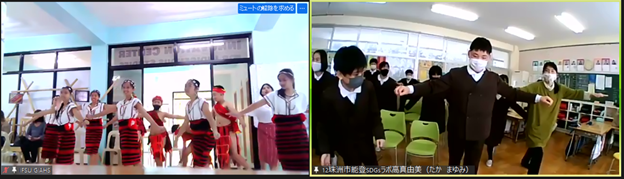
Following the introduction of the dance from Ifugao, Shoin Elementary School also gave a demonstration of the “Yakkofuri” dance, a traditional festival dance in the community, and the children of Nayon Elementary School danced it together.
珠洲市正院地区に伝わる「奴振り」を一緒に踊っている様子 Students dancing “Yakkofuri” that has been handed down in the Shoin area, Suzu City
During the question time, various questions were asked, and opinions were exchanged. For example, students asked questions such as why they wear masks when they play the drums and who designed the traditional costumes. Finally, a popular contemporary dance in the Philippines was also introduced, and all participants danced together.
At the end of the event, the principals of both schools commented on the program. Mr Yamagishi, the principal of Shoin Elementary School said that “Although there are differences in the dances and music of the two regions, it was very good to see that there are also similarities in the appreciation of the harvest in both regions.” Ms Aliguyon, the principal of Nayon Elementary School expressed her gratitude for the opportunity to carry out such a learning and fun student exchange. What was impressive about this exchange was that the elementary school students themselves played the traditional instruments and danced their local dance and were able to introduce them in their own words. This exchange was only possible because the local culture remains strong and has been passed on to the children in both regions, Noto GIAHS and Ifugao GIAHS. We believe that by introducing your own culture to the children of the same age in another country, they were able to further deepen their understanding of their region. Above all, it was a pleasure to see the children enjoying themselves as they danced together.
This marks the end of this school year’s exchanges, but we hope to continue supporting exchanges between the children in Noto and Ifugao in the future.