OUIK is mapping information for understanding the relationship between regional nature and culture. We have published the booklets “Noto’s Satoyama and Satoumi Maps” and “Kanazawa Nature and Culture Maps”.
We are collecting map information at different levels of prefectures and municipalities in the Hokuriku Region. With a focus on the keywords of biological diversity, cultural diversity and ecosystem service, we are creating tools for learning and information dissemination that meet regional needs.
Collaborative research:アーカイブ
Contribution to the understanding of biocultural diversity and ecosystem service
ごっつぉ草紙 Red data cook book
Establishment of the Noto Biodiversity Society
Five years have passed since “Noto’s Satoyama and Satoumi” was designated as a Globally Important Agricultural Heritage System (GIAHS) by the Food and Agriculture Organization of the United Nations (FAO). OUIK has supported the revision of action plans and monitoring activities after the GIAHS designation.
Biodiversity monitoring activities in Noto, which are carried out in an area that encompasses four cities and five towns, focus on surveys of living creatures conducted independently by municipal governments and private organizations; a unified monitoring system to disseminate information related to biodiversity has not yet been developed.
In response to this situation, “Noto Biodiversity Society” was established by OUIK and Kanazawa University Satoyama-satoumi Project to contribute to Noto GIAHS through monitoring of biodiversity and related activities. The members of this society include people who belong to private organizations that promote the preservation of biodiversity and environmental education in the region, as well as researchers working in laboratories related to biodiversity in Noto.
On January 23, we announced the establishment at a meeting of Noto GIAHS Utilization Executive Committee and Noto GIAHS Promotion Council, in which OUIK participates as an observer. Through surveys of living creatures and related activities, the society will contribute to the preservation and monitoring of biodiversity and dissemination of information, in cooperation with the Council.
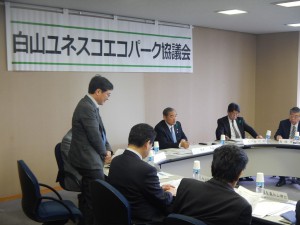
白山ユネスコエコパーク協議会の参与メンバーとなりました
OUIK Biocultural Diversity Series #5 Restoring Kinship with Nature through Japanese Gardens -The Challenge to Achieve a Sustainable Commons in Kanazawa
The book introduces unique roles and teachings of Japanese Gardens in Kanazawa City in a relation with human society and it is breaking new ground for Kanazawa’s sustainable future.
Official report of International Forum Series to Commemorate One-Year Anniversary of the 1st Asian Conference on Biocultural Diversity[Electronic Version]
After one year since the 1st Asian Conference on Biocultural Diversity, a series of 2 inernational forums were held to explore the measurements to further promote the Ishikawa Declaration with international initiatives and East Asian partner.
International Forum Series 1 (4/10/2017)
Biocultural diversity & satoyama: Effort towards societies in harmony with nature around the world.
International Forum Series 2 (15/10/2017)
Preserving Biocultural Diversity for Future Generations:Partnarship of East Aisan Countries.
Youth Capacity Building Workshop towards UN’s Sustainable Development Goals
From January 1, 2016 until 2030, United Nations adopted Sustainable Development Goals (SGDs), with 17 goals and 169 targets, to end poverty, protect the planet, and ensure prosperity for all. These goals are applied to all countries and regions, and for the next 15 years they will be the critical tools in the dialogs to solve environmental, economic and social issues. Youth capacity development towards those issues will be essential to ensure the successful achievements of those goals. This Workshop is jointly created by Kanazawa University and United Nations University, and it aims to create the platform for the younger generations to come together and deepen the discussions on SDGs and share the regional issues.
OUIK Biocultural Diversity Series #4 [Learning About the Satoyama and Satoumi of Hokuriku Region from Maps]
2-Day Noto programme held at OSAKA EXPO
On August 27, 2025, the Osaka-Kansai Expo program, “CONNECTING YOU To NOTO: Learn About Biodiversity (Resilient Creatures) with Noto Elementary School Students!,” took place at the Junior SDGs Camp(Sustainable Dome) venue on the Expo grounds. The Ministry of Environment and the United Nations University Institute for the Advanced Study of Sustainability (UNU-IAS) organized this event.
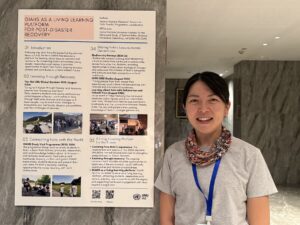
At the beginning of the program, Sayako Koyama, researcher at the United Nations University Institute for the Advanced Study of Sustainability Operating Unit Ishikawa-Kanazawa (UNU-IAS OUIK), explained the concept of biodiversity by giving examples of creatures from the Noto Peninsula. Participants learned that living things, the environment, and human life are interconnected and mutually supportive. Koyama then discussed the damage caused by last year’s Noto Peninsula earthquake and heavy rains.
Next, fifth- and sixth-grade students from Yanagida Elementary School in Noto Town, Ishikawa Prefecture, presented the results of their surveys on the water quality and wildlife of the Machino River. They had been conducting these surveys since before the disaster. The students shared their observations on post-disaster changes in the ecosystem, wildlife resilience, and the impact of environmental shifts on the food chain.
Following the elementary school student’s presentation, an online exchange session was held with Sakana-kun, who joined from Tokyo. He discussed the fish he observed during his visit to Noto and the challenges that creatures face due to earthquakes, heavy rains, climate change, and environmental issues.
Finally, the children in Osaka venue asked Sakana-kun questions. Sakana-kun drew pictures of fishes and explained their characteristics in detail, which the children listened to with great interest.
The participants had a valuable opportunity to learn about Noto’s wildlife and the situation after the earthquake.
We also received cooperation from the Institute of Noto Satoumi Education and Studies, and the Noto Marine Center in planning this program.

The day 2, on August 28, the session titled “CONNECTIN YOU to NOTO: Learning Disaster Prevention and Recovery from Affected Areas with Noto High School Students!” featured presentations by five first- and second-year Ishikawa Prefectural Nanao High School students.
After Koyama gave a presentation about the livelihoods, traditional culture, and daily life in Noto’s satoyama and satoumi areas, the high school students shared their experiences of the hardships they endured in the region and their feelings during the 2024 Noto Peninsula Earthquake and heavy rains. The students also presented their research on the changes to the local environment after the earthquake and heavy rains. They stated, “We realized that the current state of our environment and way of life is not permanent.” They also discussed the importance of water and shared their experience of going without water for nearly five months. They conveyed the idea that preparedness can minimize damage. Their appeal to learn from disasters and pass that knowledge on to future generations left a strong impression on the participants.
After the presentations, participants ranging from children to adults had group discussion. Inspired by the Noto high school students’ presentations, the participants discussed disaster prevention approaches and daily preparedness in their own regions. Some participants who had experienced the Great Hanshin-Awaji Earthquake shared their memories of that time. These dialogues fostered empathy and learning across generations and regions.
Finally, Shinobu Yamaguchi Director of UNU-IAS reflected on the programme. She stated, “Recent disasters, such as heavy rains and forest fires, are deeply linked to climate change and can occur anywhere in the world—not just in Noto or Japan. That is precisely why bringing together diverse people across generations, positions, and regions to learn together is the key to improving society”.


Although centered on the theme of disasters, this program served as a forum for shared reflection that transcended regional boundaries. It connected the past, present, and future, starting with Noto’s experiences. It offered an educational experience worthy of the international stage of the World Expo.
OUIK Biocultural Diversity Series #3 Noto Satoumi Movement-Passing on wisdom of living with the sea
It documents discussions and article contributions by speakers who participated in the OUIK Noto Satoumi Lecture Series held in 2015. This lecture series highlighted the Noto Satoumi Movement, which emphasizes local, traditional wisdom of living with the sea, and led in part to the Noto Peninsula’s designation as a Globally Important Agricultural Heritage System (GIAHS) in 2011.
The Noto Satoumi Movement aims to establish the Noto region of Ishikawa Prefecture as a leading center for satoumi research and conservation efforts on the Sea of Japan, as well as to promote a deeper awareness both in and outside of Japan of the concept of Satoumi, the charm of Noto’s satoumi and its related livelihoods, and the importance of satoumi conservation. The booklet is available from here