Collaborative research:アーカイブ
2021年07月19日
There is abundant Satoyama and Satoumi nature in the Noto region, which has developed through people’s activities over a long period of time. In 2011, Noto’s Satoyama and Satoumi were designated as GIAHS (Globally Important Agricultural Heritage Systems) by the Food and Agriculture Organization of the United Nations (FAO). Diverse activities and connections in the Noto area involving nature, living things, agriculture, forestry and fisheries, traditional skills, etc. were registered as one system consisting of 160 assets, which is being preserved and passed down to the next generation.
At the end of 2020, the United Nations University Institute for the Advanced Study of Sustainability, Operating Unit Ishikawa Kanazawa (UNU-IAS OUIK) launched a project to make a film entitled “Handing Down the Food Knowledge and Skills of Noto GIAHS” by Mr. Koyama, the research associate of UNUV IAS OUIK. The project focuses on the knowledge and skills required for food processing and preservation of agricultural and aquatic products, which have been passed down from one generation to the next in the Noto region. It aims to create a visual record through interviews with farmers and fishermen in the region, which will convey the information to future generations.
The project centres on four themes: fermented food (miso), edible wild plants, seafood (sea cucumber) and seaweed. The film will be released on the occasion of the International Conference on Noto GIAHS to be held in November 2021, in commemoration of the 10th anniversary of the designation of Noto GIAHS.
2020年01月29日
At the ninth SDGs cafe we discussed the question, “how do we want transportation in Kanazawa to be in 2030?”, with particular attention to the happiness of people and the development of attractive towns.
Our first guest was the mastermind and secretary of Kanazawa’s “machinori” bicycle rental system , Masahiro Kagishi (Nihonkai Consultant Co., Ltd.), who is also familiar with domestic and international public transport systems.

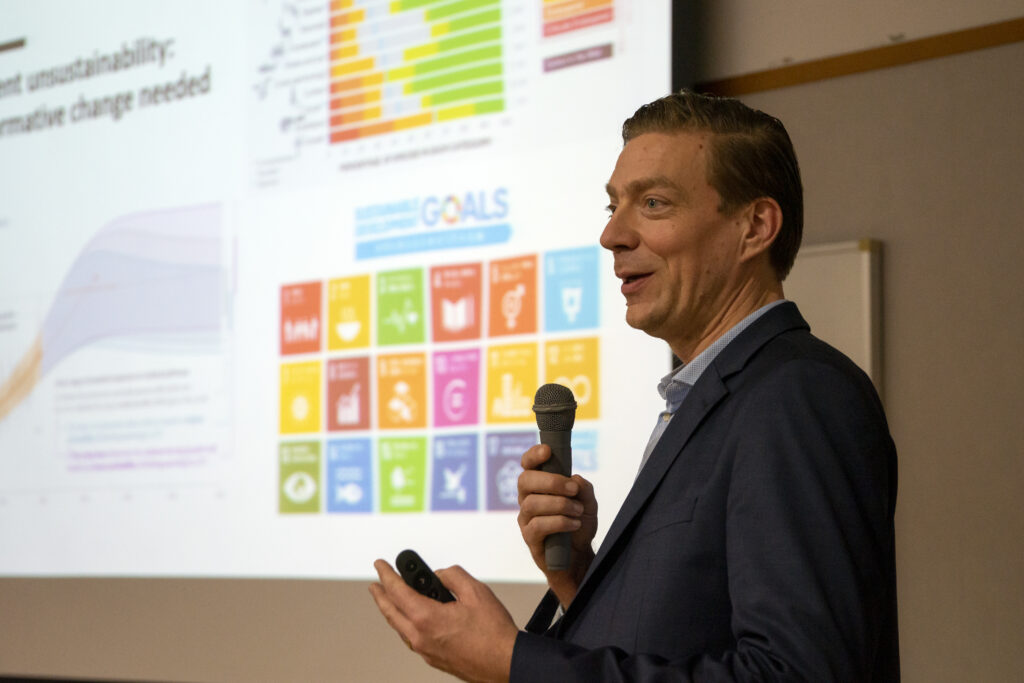
We also welcomed Derk Loorbach (director of the Dutch Research Institute for Transitions and Professor of Socio-economic Transitions at the Faculty of Social Science, both at Erasmus University Rotterdam), who was visiting Japan from the Netherlands, as our special guest. Masahiro Matsuura (Professor, Graduate School of Governance, Meiji University) cooperated as an interpreter and coordinator.
A new “machinori” will start soon
“Machinori”, the bicycle rental system created by Masahiro Katagishi, has been in operation for eight years as of January this year, with a total of 1,239,000 uses and 425,000 users. Currently, the system is being updated and the number of cycles and cycle ports will be tripled on March 1st. “I’m working hard to make it a true public transport system,” says Kagishi.
“As the global trend is transitioning from car to person and from space to place (space becomes place by adding human activities), this trend is closely related to SDGs. Before thinking about transportation, sharing the vision of how we should develop the town/city itself is important,” Mr. Katagishi said. He also introduced a service called “MaaS (Mobility as a Service),” which allows users to search, make reservations, and settle payments in an integrated manner by combining them optimally, which is getting more and more attention these days.
Three years ago, Mr. Katagishi traveled to Barcelona, Spain, where he interviewed various local transportation operators and asked, “Why is mobility necessary?”. The answer was simple but impactful for him: ”For the happiness of people. Our mission is to support people’s activities and produce a happy urban life. We will provide mobility services for that purpose. Is it different in Japan?”.
Mobility is needed for people’s happiness
Thanks to that revelation, Mr. Kagishi learned three points that support happiness:
①Accessibility: Improve the accessibility of many kinds of activity by diverse groups of people
②Multimodality: Coordination of various transportation forms in consideration of accessibility (ease of use)
③Integration: Development and transportation policies that take into account various policies such as land use, welfare, environment, and tourism (integration of various city policies is needed)
“Happiness is the emotion that you gain from various activities → movement occurs to proceed with activities → supporting people’s activities and people to access happiness” = Mobility, Mr. Kagishi said.
Then how about Kanazawa as a city and its transportation from the perspective of happiness?
Mr. Kawagoshi said that many great ideas have already been shared for transportation and community development for the future of Kanazawa City. However it is not progressing easily because stakeholders are not sharing a common vision like his idea of mobility-based happiness yet.
However, based on the environmental and social aspects of the five directions of the Kanazawa SDGs, Mr. Kawagishi hopes that there would be more opportunities where open discussions can be held in the future.
Imagine traffic in Kanazawa in 2030
”Technologies such as AI, autonomous driving, and MaaS apps are means, not goals,” Mr. Kawagishi said.
“First, enjoy yourself.” He says that it is important to think about “What are the attractions and activities of Kanazawa that you want to cherish? What is unique about Kanazawa?” Then, in order to realize happiness, consider the ideal way of mobility to support it, create a transition, and create a human-centered world in Kanazawa where citizens and tourists both can enjoy moving around.
“How to make a transition?” by the pioneer of mobility transition
So how do we rebuild mobility for future happiness? Derk Loorbach, a professional of mobility involved not only in research but also in its real-life application, made a proposal to improve the sustainability of the city.
“For example, climate change and the loss of biodiversity are recognized worldwide, but there is no real action, and that’s the problem. People are aware of it and they even know the solution but there is still no action. How can we make a big change there? That’s what we focus on,” said Mr. Derk.
Transition starts with thinking about a sustainable society, and we need to have critical thinking sometimes. The study of transition does not mean thinking about what has happened now, but rather thinking about why things aren’t changing, and how we can enact change.
“When I talk about transition, some people take a negative stance and call me an idealist or a dreamer, saying it can’t be done, and it costs money. It isn’t easy to believe in the future, but increasing the number of people who believe in change and the future is a part of the transition process.” Mr. Derk said.
At first, it might just be a few bureaucrats in a government office or employees in a large company, but the transition begins when those people successfully make friends and try various experiments and methods to begin a transition. As it grows, the shape becomes visible–in Kanazawa, for example, the number of bicycle lanes has increased considerably these past few years. In the same way,things that will be considered normalin the future but are still not common right now will gradually develop to become the norm.
“There’s a project called “place of transition” where people who can make a change come together and think about what kind of transitions are possible. The aim of this idea is for the participants to get back to their workplace or community and create opportunities for movement as an organization,” Mr. Derk said.
Mr. Derk also introduced us to a number of actions taken in cities in Europe. For example, in Ghent, which is one of Kanazawa’s sister cities, there is an initiative called “Living Street”, a project to close the streets to traffic for two months during the summer and use them as parks. Apparently it took two years to persuade the relevant departments, and in the first year it was carried out in only 2 streets where cars hardly could pass. After a few years, more streets joined the project. In another example, this time in Rotterdam, the government was undertaking a mobility transition project and they noticed that some people were being excluded. For example, poor people can’t commute, can’t move, or can’t ride a bike because they have no money. This was perceived as a social welfare issue, and free bicycles were offered.
It seems that the transition has changed the mindset of officials who did not like rapid changes until now, and they are now trying more and more experiments. Until now, the idea was “to solve problems when they occur”, but it is said that the idea has been shifted to “creating problems on purpose and providing solutions.”
There were a lot of deep questions at the question time.
Everyone seemed to be having a lot of problems and asked a lot of questions. Here are some of them.
<Questioner A>
People in Kanazawa hardly think about public transport. What should we do to change the consciousness of these people?
<Derk>
Some people may be uninterested or find it annoying, so the point is to start small. It’s also important to start by connecting with people who are already active and making it visible.
<Questioner B>
In the Netherlands, it rains a lot, but I hear that lots of people ride bicycles. On the other hand, people in Kanazawa say that bicycles cannot be used because it rains and snows here. How has the Netherlands encouraged people to use their bikes in the rain?
<Derk>
In the Netherlands, where a bicycle infrastructure is available, riding a bicycle is easier than riding a car. In Kanazawa, it may be easier to drive. Whether it is raining or snowing, it’s important to try out a bike tour or an event together, make it visible, and make it seem normal.
<Questioner C>
How did the results of the transition experiment affect the economy?
<Derk>
When talking about a case where a parking spot on the street was turned into a park as an example, we asked the shop owners or residents in front of us, “Do you want to do it?”. At first they said no because customers could not come in if they closed the street, but when they actually tried it, they realized that creating an attractive space increases the number of customers. This project gradually spread, and in Rotterdam 4,000 parking spaces have now been converted to parks. We have also calculated that zero emissions will bring various social benefits, improve health, and reduce costs. As for which sector suffers the greatest damage, the fact is that the government has a lower tax revenue, and that’s the greatest impact.
<Questioner D>
In your experience, are there any examples where tourism has become more active as a result of a transition?
<Derk>
Like Barcelona and Rotterdam, a city that is easy to walk and comfortable to live in would have more benefits in tourism. The point is not to shut down the car immediately, but to give more options to people, for example allowing only electric cars and providing other transportation methods.
<Mr. Katagishi>
It would be amazing if Kanazawa becomes a city like Zermatt where only electric cars are allowed. I feel like it would be better to change people’s mindset in that kind of direction.
<Question from Katagishi-san to Mr. Derk>
How did you make everyone agree to one person’s idea as a policy? I would like to know if you have any tips.
<Derk>
Making a plan that says “everyone agreed” and expecting it be implemented someday is just a dream or an illusion. We should focus on people’s actions, how we can all positively keep working for a better future. If you have a strong opinion of what the future should look like, you should talk and connect with individuals who are in tune with that belief, and in that case you don’t need all the stakeholders to agree with you.
More than 60 people gathered to participate in this event, likely because the theme of “transportation” was familiar and relevant to their lives. Derk said, “I would start with the little things like this cafe first. This could be the start of something big, I believe it could”.
The official website of Kanazawa SDGs IMAGINE KANAZAWA 2030 has been launched. Check out the upcoming SDGs cafe schedule as well. Https://kanazawa-sdgs.jp
2021年07月19日
We are pleased to inform you that a journal article co-authored by our UNU-IAS OUIK researchers, visiting research fellow Akira Nagata, and research consultant Evonne Yiu, titled “Ten Years of GIAHS Development in Japan”, has been published inn the latest issue of the Journal of Resources and Ecology, volume 12, 4th edition, on 13 July 2021. The article highlights the development of FAO’s “Globally Important Agricultural Heritage Systems (GIAHS)” in Japan since its introduction to Japan ten years ago. You access the article by clicking here.
2019年12月26日
On December 17th, the 2019 Hokuriku SDGs Stakeholder Meeting was held jointly with the Kanazawa Institute of Technology at the Kanazawa Theatre.
This meeting was held as a regional version of the Stakeholders Meeting for Revision of the SDGs Implementation Guidelines hosted at the United Nations University Headquarters on September 6, 2019. People from various parts of the Hokuriku region, including those from the private business sector, local governments, and citizens who had already been working on SDGs participated in this meeting and discussed the future of Hokuriku region and presented a sustainable plan for the future, looking forward to the next generation.
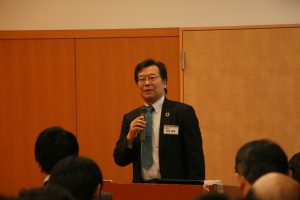
First, Mr. Kazuhiko Takemoto, a visiting professor at the United Nations University Institute for the Sustainability Advanced Studies, gave an opening speech. He talked about the importance of such a meeting being held in rural areas when the implementation guidelines for the SDGs are revised at the end of the year.
Next, Mr. Kentaro Endo, Counselor of the Cabinet Office Regional Revitalization Promotion Secretariat, gave a greeting and explained the nation’s policy towards achieving SDGs and regional revitalization.
In addition, Associate Prof. Shintaro Hiramoto, Director of the SDGs Promotion Centre at the Kanazawa Institute of Technology, shared information and explained the purpose of the meeting and how to proceed with the breakout sessions.
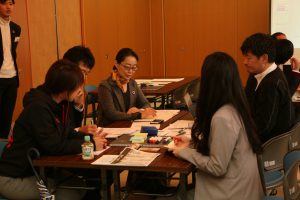
The meeting was divided into 5 subsequent sessions, and each group produced a specific plan for Hokuriku in 2030 in the form of a scenario.
① What does it mean to be a comfortable city for everyone to live in?
Why do people, money, things, and information gather in Tokyo? How can we apply the SDGs perspective to revitalize the region and change this trend?
Facilitator: Yuki Mishima (President of Fork and Landscape Designer) Tatsuya Kitagawa (Department of Information Management, Kanazawa Institute of Technology)
②Innovation: Production in the countryside and transmission to the world: What do we produce and transmit, and how do we gain the world’s understanding? Will the SDGs be its common language, and how will it co-exist with technology?
Facilitator: Hiromi Onuma (Representative of Hiro), Kenichiro Fukushima (Representative Director of Code for Kanazawa, Representative Director of Eye Publishing Inc.)
③ Education: Careers and learning in a 100-year lifetime society:
How do you enjoy and build a career over a lifetime of 100 years?
Facilitator: Naoki Miyatani (Start SDGs Operation Manager) Shoko Maruyama (Family Business Facilitator)
④Partnership: A mechanism to bring everyone’s power together in the community
-How can various actors co-create across sectors and organizations in order to achieve the SDGs?
Facilitator: Hirofumi Taniuchi (Kanazawa City Citizens’ Activities Support Center) Naoyuki Tsukamoto (Company Inc.)
⑤ Diversity: A society where diverse people can participate in decision making
How will our lives change if we can create a society where diverse people can participate in decision-making?
Facilitator: Kenji Kitamura (Coordinator of Social Division, Noto SDGs Laboratory) Sayaka Watanabe (Representative of re: terra)
During each session, members first looked over materials such as the NRI Future Chronological Table 2020-2100 and the Ministry of Internal Affairs and Communications’ TECH Strategy for the Future. They then drew up a vision of what work styles and lifestyles might be like in 2045. Next, members created a “persona,” a hypothetical person whose life they would simulate through an example scenario, including specific details of their life story and turning points.
After the afternoon breakout sessions, the scenarios were reported to the local students, the next generation who would hold the future of Hokuriku region. Many ideas were shared, such as the systems enabled by technological advances and changes in family structure.

Thank you to all of the participants who took their work seriously to the end. We also thank the students who participated in the sharing session in the end.
2021年07月15日
IMAGINE KANAZAWA 2030 Partners is a platform for implementing the Kanazawa Future Visions action plan through partnerships. One year after its establishment, it has developed into a large platform used by 140 companies, organisations and individuals.
The third Partners Exchange Meeting was held on July 13 with as many as fifty participants. At the meetings this year, short presentations will be given on “projects to be carried out through collaboration between partners” and “topics to be discussed with partners,” and discussions based on the presentations will be held subsequently. Today, five companies and organisations gave short presentations on their activities, and participants were divided into five discussion groups.
The following five companies and organisations gave presentations today:
1) Nomura Securities Co., Ltd.: “Sustainability transformation (SX)”
2) kanazaWAZA Laboratory: “Sustain-art Project: Abandoned bamboo forests”
3) Code for Kanazawa: “Call for participation in the regional problem-solving competition”
4) Ishikawa’s Morning Catch Project Secretariat, Ishikawa Chuo Uoichi Corporation: “Promotion of sustainable seafood distribution”
5) Lotus Concept Co., Ltd.: “Hands-on promotion of barley straws”
Nomura Securities Co., Ltd.introduced ESG-based investment predicated on sympathy and support, and the ecosystem for sustainable transformation in Kanazawa. They explained their intention of teaching high school students about ESG-based investment.
kanazaWAZA Laboratory. explained how they are using art to solve the problem of abandoned bamboo forests in Kanazawa. They are planning a circulation-model art project, which involves the management of bamboo forests by felling, bamboo art production and soil improvement through the reuse of bamboo. Their work is being carried out in collaboration with various parties such as major companies, government, residents and educational institutions.
Code for Kanazawa aims to solve regional problems through IT and design. They introduced their regional problem-solving competition, the goal of which is to solve regional problems through ICT.
Ishikawa’s Morning Catch Project Secretariat, Ishikawa Chuo Uoichi Corporation explained their project for the promotion of eco labels. There are various eco-label accreditation systems such as MEL (Marine Eco Label), MSC (Marine Stewardship Council) and ASC (Aquaculture Stewardship Council). Products are accredited based on an evaluation of sustainability and environmental impact reduction associated with catching and cultivation methods. They talked about their plan to diffuse information and hold events featuring accredited products.
Lastly, Lotus Concept Co., Ltd. introduced the barley straws they manufacture and sell. They are trying to popularise barley straws in order to reduce the environmental impact caused by the production and disposal of plastic straws. Their straws, which are made of barley from Komatsu City, Ishikawa, are used at Senshu University and at hotels in Kanazawa.
Group discussions were held after the presentations. The presenters talked about their motivation and passion, and participants asked questions and made proposals. The discussions seemed to be a good opportunity to create something new through collaboration.
2019年11月28日
This SDGs Café’s topic was “partnership”. We invited Mr. Hiroishi from K.K. Empublic and Ms. Kasama from the Kanazawa City Government as guest speakers to imagine Kanazawa in 2030. The SDGs can only be realized through strong partnerships, a point made clear by the explicit inclusion of partnerships in the Goals themselves (Goal 17: Partnerships for the Goals). After Ms. Nagai from OUIK introduced the collaborative project between Kanazawa City and JC Kanazawa, Ms. Kasama commented that “My dream is that in 2030, Kanazawa will be a city where everyone can naturally work together to solve social issues.”
Mr. Hiroishi, who works on various partnership projects, introduced problem-solving processes and methods. He explained that ”complex problems” and “difficult problems” are different: difficult problems can be answered, but today’s social problems are complex, with diverse elements and complex contexts that interact and intertwine, so the main cause of the problem cannot be identified. Until now, we have solved one problem at a time. In other words, the only premise is a “problem-free situation”. “What is a problem-free situation? And is it really a good approach to solve problems one by one? At the end of the day it might be quicker and the total cost is cheaper if we try to make a situation where everyone is happy. ” Dynamic problems that are occurring in the system and those that are caused by complex factors require complex solutions. When a problem occurs, it is not something that can be solved if someone does something, rather it is necessary for the local community and society to improve so that they can either solve problems or prevent them in their early stages.
After Mr. Hiroishi’s presentation, participants had a discussion over a newly introduced SDGs action plan for Kanazawa.
2019年11月15日
On October 30, 2019, a Japan-Korea International Conference titled “Achieving SDGs Through the Conservation of GIAHS” was held in Kanazawa city.
A joint 3-year project between the United Nations University Institute for the Advanced Studies of Sustainability (UNU-IAS) and the National Institute of Agricultural Sciences of Korea Rural Development Administration (RDA) commenced in January 2018 to conduct comparative research on the “Globally Important Agricultural Heritage Systems (GIAHS)” designated by FAO and the Nationally Important Agricultural Heritage Systems (NIAHS) in Japan and Korea. The Conference was held as part of this joint project to share experiences from both countries on the GIAHS designation’s impact and conservation challenges, with a particular focus on the relevance of GIAHS conservation in the achievement of the UN Sustainable Development Goals (SDGs).
In his opening remarks, UNU-IAS OUIK Director Dr. Tsunao Watanabe introduced GIAHS-related efforts in the Noto region of Ishikawa Prefecture. He urged the participants to think creatively on how GIAHS, with 57 designated sites in 21 countries, can contribute to the SDGs in the future. He added that agriculture and biocultural diversity would likely be an important theme at the 15th Meeting of the Convention of Biological Diversity Conference of the Parties (CBD COP15), to be held in Kunming, China next year, and expressed UNU-IAS OUIK’s commitment to raise awareness of GIAHS and promote further discussions on GIAHS stakeholders in various countries.
Dr. Dae Yong Hwang, senior agricultural researcher at RDA, also gave opening remarks, including condolences to the victims of Typhoon Hagibis and reports on the activities of GIAHS and NIAHS in Korea. He informed the Conference that the first international conference for the joint project was held in Korea last year, and that following the hosting by Japan this year, a final conference will be held next year in Korea. He stated that he looked forward to the fruitful discussions from this Conference, which he believed would be beneficial to current ongoing research.
In the first keynote lecture, UNU-IAS Academic Program Director Dr. Osamu Saito gave a lecture entitled “The Future and Sustainability of Satoyama-Satoumi”. Dr. Saito has been conducting research to explore the relationship between social capital and dietary habits through the “Survey on the Proportion of Self-Consumption in the Diet” and the “Survey on the Culture of Sharing in the Noto Peninsula”. While sharing his analysis of natural capital and ecosystem services in the integrated social and ecological systems in the Noto region, he said that it is important to promote community development based on future scenarios, and to create a community-based recycling society in collaboration with rural and urban areas.
In the second keynote lecture, RDA researcher Dr. Myeong Cheol Jeong gave his presentation on the “Current Status of Conservation and Utilization of GIAHS in Korea”, where he introduced some popular activities of Korean GIAHS sites such as agricultural experience programs, art-related programs, rice field ownership systems, and farm tourism. He stressed the importance of sharing common goals on GIAHS with interest holders from both within and without the region, and stated that he would like to promote the standardization of appropriate regulations and indicators in the future.
In the last keynote lecture, Mrs. Junko Owada, a member of the Japan GIAHS Expert Committee, shared the results of her research on “Activating GIAHS from an SDGs Perspective: Results from the Japan-Korea GIAHS-SDGs Survey”. According to her findings, all 11 GIAHS regions in Japan are working on SDGs, particularly Goals 2 (Agriculture) and 15 (Life on Land). Although there are variations depending on the region, she expects to see that Goals 6 (Water) and 12 (Responsible Production and Consumption) will be given more emphasis in the future.
After the break, a series of GIAHS experiences were presented. Firstly, Mr. Naoyuki Kaneda, Director of the Planning and Finance Section, Suzu City Hall, Japan, presented on “SDGs x GIAHS x Art”. As part of their GIAHS conservation efforts, Suzu City has focused their efforts on education, including conducting biological surveys at all nine elementary schools in the city, and financing the Satoyama Meister diploma programme to nurture a rural workforce.
To raise the profile of the city, Suzu City introduced the triennial Okuno Noto International Art Festival in 2017 to bridge art with rural farming landscapes and seascapes, which was well received. Such efforts led to the selection of Suzu City as one of the “SDGs Future City” in Japan by the Cabinet Office. Suzu City then also established the Noto SDGs Lab in 2018, and continues to work on various initiatives in collaboration with universities and companies. Mr. Kaneda recognized the need to clarify the impact of these efforts on the local economy and how they contribute to the revitalization of the city.
In the GIAHS case study in Korea entitled “Multiple Functions and Utilization of Traditional Tea Farming in Hadong”, Mr. Jong Gon Kim, Head of the Hadong Tea Producers Association in Hadong County, talked about business and hiking course development. He also discussed problems unique to Korea’s leading tea production area, such as the confrontation between traditional tea farmers and farmers who are developing large-scale tea plantations for commercial purposes. He also shared that Hadong will host the World Tea Expo in 2020.
Introducing the case study on Japan’s Nationally Important Agricultural Heritage Systems (NIAHS), Ms. Tomoe Aota, Deputy Director of the Shiga Prefecture Agricultural Policy Division, Agriculture, and Fisheries Department, spoke about “Lake Biwa System and SDGs”. In 2016, Shiga Prefecture established its Agricultural Heritage Section to promote awareness of Lake Biwa as an ancient lake with 4 million years of history, and its connection with local culture and the surrounding environment, including forests, rivers, paddy fields and lakes. It is currently recognized as a Japanese NIAHS and is applying to become a GIAHS.
In the final case study presentation, Dr. Hag Yeo You, a research committee member at Chungnam Institute, gave a presentation titled “Sustainability of the Traditional Ginseng Agricultural System”. Dr. You said that while it is wonderful to be designated as GIAHS, there are still various challenges for the future. In particular, he pointed out the need to develop indicators for monitoring these systems, and designating who will be responsible for conducting said monitoring. He emphasized that it is necessary to confront these problems by encouraging the participation of local people.
In a panel discussion moderated by UNU-IAS Research Fellow Dr. Evonne Yiu, the speakers, along with Prof. Yoo Jick Lee, Vice President of the Korea Rural Heritage Association, discussed regional revitalization and the contribution of GIAHS to the achievement of international goals such as SDGs. Prof. Lee said that in Korea, SDGs are still mainly taken up by the central and provincial governments, so he was impressed by the efforts of Suzu City at the municipal level. He hopes to see SDGs used as monitoring indicators for the GIAHS action plan in Korea. One of the common issues that GIAHS in Japan and Korea both have is the low public awareness of GIAHS. In response, Ms. Aota suggested that SDGs could be helpful to raise the awareness of GIAHs, as interest in GIAHS amongst companies and civil society in Japan are heightening these days.
Concluding the Conference discussions, Kanazawa University Emeritus Professor and East Asia Research Association for Agricultural Heritage Society (ERAHS) Japan Chairman Prof. Koji Nakamura reflected on the key challenges discussed. Prof. Nakamura stressed that the challenge of GIAHS conservation will only get harder after designation, especially the cycle of monitoring, revision of the action plan, and upscaling that must be addressed with the involvement of all stakeholders in the designated region. To that end, he said that the most important thing is human resource development, highlighting the success of the Meister program in the Ifugao GIAHS, the Philippines, which he founded and has worked on for many years.
Lastly, Mr. Shinji Terasaki, Director of the Ishikawa Prefecture Satoyama Promotion Office, Agriculture, Forestry and Fisheries Department, gave the closing speech, thanking RDA and the participants, and expressed commitment to further the work of GIAHS, bringing the four-hour conference to a close.
2021年04月12日
On Sunday, 28th of March, a Garden Maintenance SDG Tour was carried out at the Senda Family Garden (closed to the public), which has been designated as a place of scenic beauty by Kanazawa City. Our research associate Juan Pastor Ivars has held garden maintenance workshops for residents to experience the nature and culture of Kanazawa. This tour was planned as a model tour for involving tourists in garden maintenance, as part of the fiscal 2020 Kanazawa City SDG Tourism Promotion Project.
Volunteer maintenance of Japanese-style gardens has been carried out by city officials, researchers and students, including people from the Landscape Policy Department of Kanazawa City and Kanazawa College of Art. Since first participating in the project in 2017, Juan has created a hands-on program consisting of garden maintenance, workshops on the history and maintenance of gardens, and tea ceremonies, and has worked to establish and increase public awareness of the program.
Urban green areas such as Japanese-style gardens are an effective means of combating global warming and the heat island phenomenon, and play an important role in the preservation of native urban ecosystems and biodiversity. In Kanazawa, gardens have contributed to the preservation of cultural activities such as handicraft production and the tea ceremony, as well as cultural landscapes. Spending time in nature is said to be beneficial for people’s mental and physical health. However, due to demographic changes, problems such as a shortage of maintenance workers are making it difficult to preserve the nature and cultural landscapes of the city, as well as the associated cultural activities, and hand them down to future generations.
In order to solve these problems, Juan searched for ways of raising people’s awareness of garden maintenance as “ecotourism”. This workshop was planned through collaboration with You-I Japan, which excels in international exchange activities. It served as a model tour for preserving the green areas and culture of the city through cooperation between tourists and residents. This SDG tour followed Utastuyama Temple District and Eikyu-ji Temple Tour.
Although it was drizzling on the day of the tour, eight people, including Japanese students of Kanazawa Institute of Technology and Russian students of Kanazawa University, assembled in front of the Senda Family Garden at 9:00 am. First of all, Mr. Tsuba from Kanazawa College of Art, who is involved in garden restoration, explained the garden’s design. The central location of the pond allows it to be viewed from the path, and the pond’s water flows out of and back into the nearby Onosho Canal. The trees and stones are arranged to resemble cranes and turtles, symbols of longevity, when seen beyond the pond from the guest room. The participants learned about the sophisticated artistry of Japanese-style gardens. Next, they worked in pairs to remove dirt that had accumulated at the bottom of the pond. They were so concentrated that the work was done in silence. The amount of accumulated dirt in different areas depended on the flow of the water.
After cleaning the bottom of the pond, the participants took a short break, and then the garden’s owner, Mr. Senda, explained the history of the garden. The Senda Family Garden was constructed by Senda Tobumi, who had great success in the Seinan War, which took place in the middle of the Meiji period. Mr. Senda showed photos of the gradual changes in the garden’s design that were made over time. The design of the area around the earthen-floor porch, where azalea trees are planted now, was different before. Also, there used to be a waterwheel beside the waterfall in the stone arrangement. Mr. Senda is considering opening the garden to the public, as it combines the scenic beauty created by a garden ecosystem with historical and cultural value, and creating an exhibition on the history of Senda Tobumi.
Before starting the tour, the participants surveyed the species of living things in the garden. Many species, including shrimp, dragonfly larvae, dark sleeper and sweetfish were found in the pond. It was a valuable opportunity to learn about the garden’s nature and culture.
Lastly, the participants had discussions. It seems that these days, tourists prefer to have unique experiences by exploring areas thoroughly and learning about their unique characteristics. The garden workshop has the potential to become part of a tour; however, it would be necessary to explain differences in gardening techniques, as well as local history and culture, to people from countries with different cultural backgrounds. One of the foreign participants commented on the excellence of Japanese landscape-gardening techniques.
We will continue to consider model tours that can contribute to the management of the greenery and culture of the city through collaboration between residents and tourists, and hand down the values of nature and culture to future generations.
2021年03月22日
Nearly 10 years have passed since “Noto’s Satoyama and Satoumi” was registered as a GIAHS site in June 2011, based on a recommendation from the Noto GIAHS Promotion Council, which consists of representatives from municipalities of the Noto region. The promotion council has created plans for the preservation and use of Noto’s Satoyama and Satoumi, and at present, the second action plan is being revised. OUIK is also working on the revision in collaboration with Ishikawa Prefecture and the promotion council, and providing advice on the preservation and use of Noto’s Satoyama and Satoumi, as well as on how to establish a platform for people from various fields to join the project.
The promotion council is now preparing for the establishment of a working group on biodiversity in Noto, involving specialists, and OUIK is also supporting the work. On February 26, the first preparatory meeting for the establishment of the working group was held at Ishikawa Prefecture Fisheries Research Center (Noto-cho). Current activities and problems related to biodiversity in the Noto region were discussed.
2019年10月25日
At this SDGs café, we finally talked about “Climate Change”. The timing and choice of topic couldn’t have been more appropriate, as Japan had been hit by one of the biggest typhoons in history just a few days before the event. Our guest speakers were Ms. Kanako Oku from the Association for Re-Designing Earth’s Future (地球の未来をリデザインする会), Ms. Ikuho Kawauchi from Kanazawa University, and Ms. Mariko Aoumi from Kanazawa Eco Life Club. The facilitator was Ms. Mikiko Nagai from UNU-IAS OUIIK.
According to Ms. Kawauchi, surprisingly, there are still many people who are skeptical about whether human activities are causing climate change. However, the data shows that the increase in CO2 over the past few decades has been leading to rising ocean temperatures. Mass use of fossil fuel is the biggest cause of increasing CO2 levels. “We are now at the point of no return” Ms. Kanauchi said.
Currently, 80% of energy is generated by fossil fuel on Earth, but the cost of solar panels or wind turbines are getting lower and lower, and it is technically possible to cover all the energy we need with renewable and sustainable energy such as solar, tidal, wind, and geothermal. Ms. Aoumi followed “I want everyone to think about what we can do about this issue.” At the end of the day it is a problem for everyone who lives in this planet. One’s actions can have an impact on someone else, and little by little they could change the future of the Earth.