

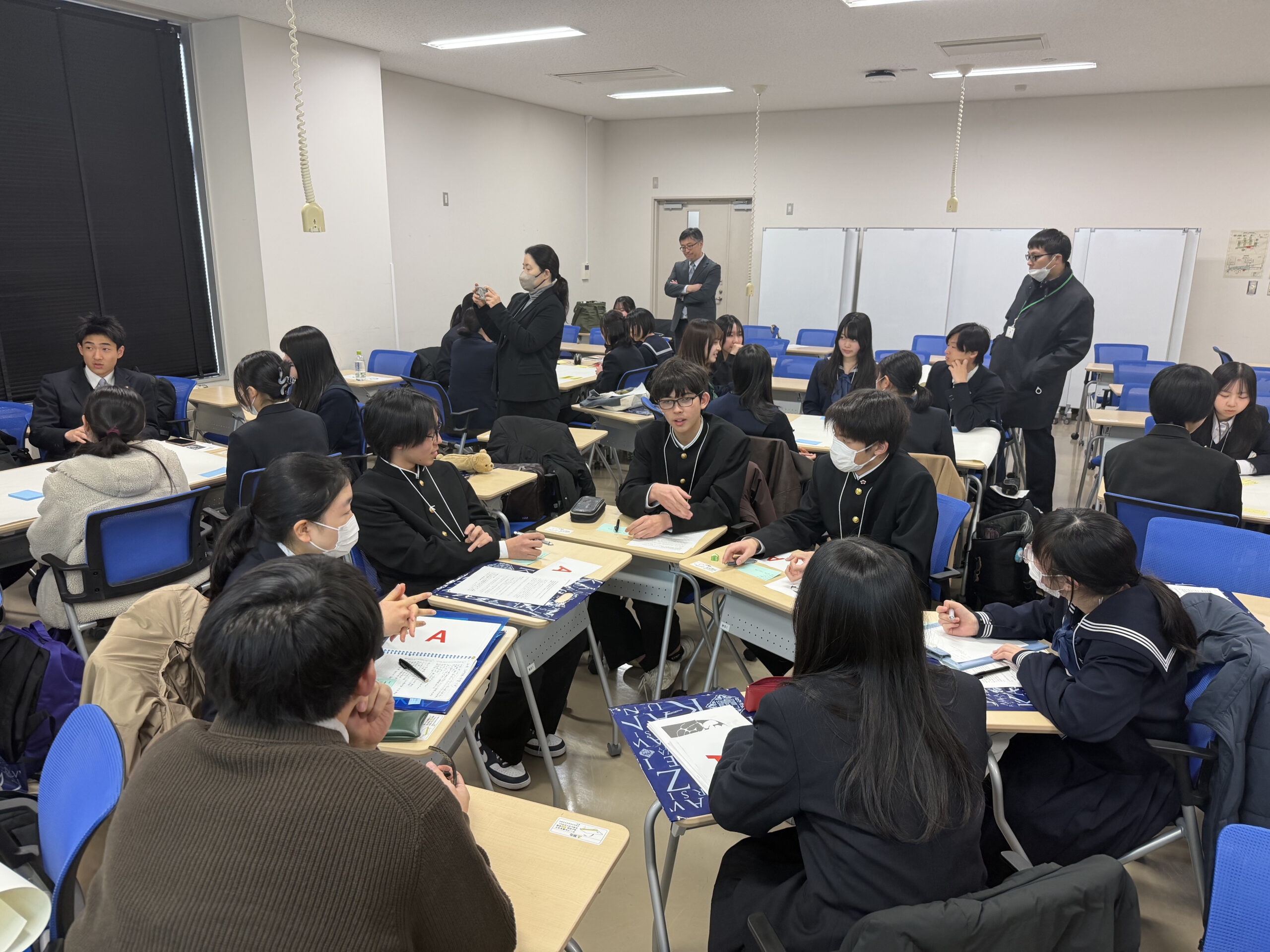
On March 14, 2026, the United Nations University Institute for the Advanced Study of Sustainability Operating Unit Ishikawa/Kanazawa (UNU-IAS OUIK) hosted an event titled “Youth and the Climate Action Conference 2026,” held as a side event of “Mirai Shikou Kanazawa” (Future-Oriented Kanazawa). This year’s theme was “Climate Justice”, focusing on the unequal impacts and responsibilities associated with climate change and examining what fair and equitable climate action should look like.
Understanding Climate Change and Climate Justice
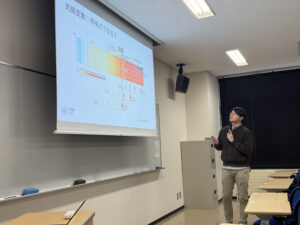
First, Dr Naoyuki Okano (Programme Officer, UNU-IAS) delivered a lecture providing an overview of the scientific basis of climate change. He also introduced perspectives that frame climate change not merely as an environmental issue, but as one deeply connected to ethics, politics, and society. He also referred discussions on the concept of “justice” in legal and political philosophy, raising questions about who justice is for and how it should be realized within society.
He explained that climate justice refers an approach that evaluates climate policies from the perspectives of fairness and human rights, recognizing that the responsibilities for and impacts of climate change are unevenly distributed across countries and regions, generations, and social groups. Although there is no single correct answer to issues of climate change and justice, it was emphasized that asking these questions in the first place is of great importance. For the students, it served as an opportunity to encounter “justice” as one of the perspectives to consider when thinking about climate change and broader social issues.
Insights from the Noto and Kanazawa Cases
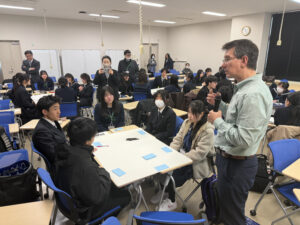
Ms. Koyama (Research Associate, UNU-IAS OUIK) explained the impacts of climate change on agriculture, fisheries, and food culture, using the Globally Important Agricultural Heritage System (GIAHS) “Noto’s Satoyama and Satoumi” as an example. Referring also to the compound disasters of the 2024 Noto Peninsula earthquake and heavy rainfall, she introduced emerging changes in local livelihoods, such as a decline in rice quality and the impacts of rising sea temperatures on fisheries. She pointed out that people living in rural areas who rely on natural resources for their livelihoods are particularly vulnerable to the direct impacts of climate change. She also mentioned trade-offs such as how power generation facilities built to supply electricity to cities can effect rural landscapes and ecosystems. From these points, it was highlighted that the level of responsibility for emissions and the degree of impact experienced are not necessarily aligned across regions, which represents an important issue from the perspective of climate justice.
Dr Juan (Research Fellow, UNU-IAS OUIK) discussed climate justice from an urban perspective, using Kanazawa as an example to explain issues such as disparities in access to urban green spaces and nature, urban heat island effects, and flood risks. In advancing urban climate action, it was emphasized that a crucial perspective is to consider who benefits and who can participate in decision-making. He also introduced initiatives that aim to build fair and sustainable cities through Nature-based Solutions and citizen-participatory research.
Workshop: Exploring Climate Change and Climate Justice in Our Daily Lives
After the lectures, students were divided into small groups and discussed how tclimate change affects their daily lives. Students shared familiar examples, such as extreme heat, heavy rainfall, changes in snowfall patterns, and impacts on food and transportation. They discussed who is affected and in what ways and exchanged ideas on actions that could contribute to a more equitable society. In the final presentations from the group discussions, students shared perspectives on the importance of mutual support within local communities and on how systems could be created to enable urban residents to support farmers and rural livelihoods. They also presented concrete ideas, such as environmentally conscious ways to support people who are vulnerable to heat, particularly older adults, during increasingly severe summer temperatures.
COP30 Report by High School Students
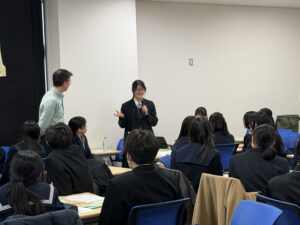
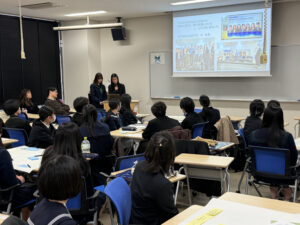
In the latter half of the event, two students from Kanazawa University Senior High School and Kanazawa Nishikigaoka High School—participants in the “Youth Empowerment Programme Ishikawa Kanazawa 2025 Training Course” —presented their experiences from attending COP30, held in Belém, Brazil. The students shared their experiences of participating in youth dialogue sessions and other pavilion events at COPe, where they exchanged views on climate action with young people around the world. They also spoke about the potential for more effective climate action to emerge when young people’s perspectives are combined with adults’ knowledge and experience.
*Applications for the Youth Empowerment Programme Ishikawa Kanazawa 2026 will open shortly. For further details, please visit the official webpage.
Bringing Climate Justice into Our Own Actions
Through this event, students were encouraged to view climate change not only as an environmental issue, but through the lenses of social equity, intergenerational responsibility, and its connections to community life. UNU-IAS OUIK will continue to advance initiatives to build a sustainable and just society, working with the next generation while connecting local case studies with global discussions.