
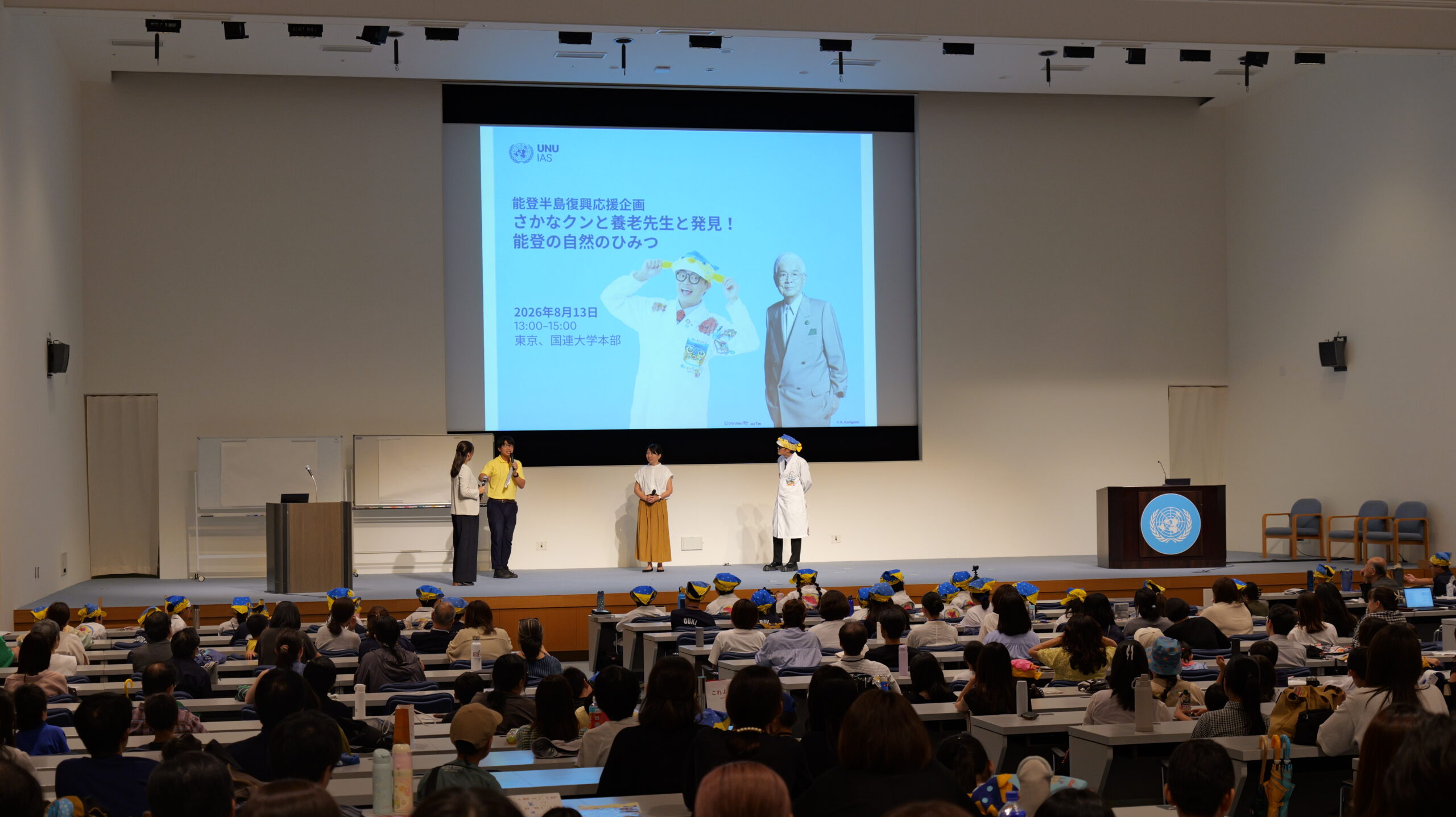
On 13 August 2026, UNU-IAS OUIK hosted the event “Noto Peninsula Reconstruction Support: Discover the Secrets of Noto’s Nature with FISH BOY -Sakana-kun and Dr. Yoro” at U Thant International Conference Hall. The event explored Noto’s natural environment and the connections between its forests, rivers, seas and wildlife following the 2024 earthquake and heavy rainfall. The event featured FISH BOY – Sakana-kun, who was appointed as a Visiting Research Fellow at UNU-IAS this year. It was organized by UNU-IAS OUIK, with support from SD BlueEarth’s “Sakana-kun Tankyutai 2026” and cooperation from ANAN INTERNATIONAL, INC.
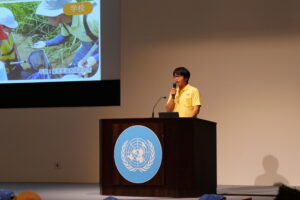
The first part introduced the connections between Noto’s forests, rivers and seas, highlighting the region’s biodiversity and unique species, including the Arctic lamprey (Lethenteron camtschaticum). In the Short Presentations, Ms. Sayako Koyama (Research Associate, UNU-IAS OUIK) presented “Noto’s Satoyama and Satoumi: Connecting Nature and People”. She explained that Noto is a region rich in biodiversity and cultural diversity, and described how the area was affected by the earthquake and heavy rainfall. Dr. Hiroaki Arakawa (Noto Marine Center) presented “Exploring Noto’s Nature Through the Lamprey: A Journey Between River and Sea”. He explained the ecology of the lamprey and emphasized that, following the earthquake and heavy rainfall, aquatic habitats have changed significantly. He also stressed the importance of dialogue with a diverse range of stakeholders to protect and restore Noto’s rich ecosystem.
In a Q&A session, participants raised many questions, including why lampreys can survive in both freshwater and seawater, and how far they travel in the ocean before returning to their natal river.
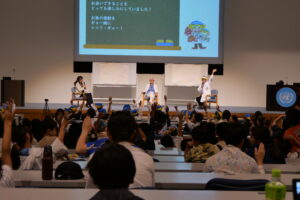
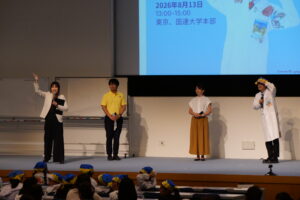
The second part featured a conversation between FISH BOY – Sakana-kun and Dr. Yoro on the theme “What Did the Living Creatures Do After the Earthquake?” exploring how wildlife has responded to changes in the natural environment following the recent disasters and discussing the future of Noto’s ecosystems. Dr. Yoro explained the interconnectedness of forests, rivers and the sea, noting that marine creatures such as shrimp belong to the same group of arthropods as insects. Sakana-kun pointed out that human-managed Satoyama landscapes help sustain a rich diversity of wildlife, mushrooms and edible wild plants. He added that nutrients from these landscapes flow into the sea, contributing to the richness of marine ecosystems. Regarding disaster preparedness, Dr. Yoro advised that the most important preparation for unpredictable disasters is having the resolve to face whatever may happen. Sakana-kun stressed that visiting disaster-affected areas and staying in touch with people can provide meaningful support and encouragement to those impacted by disasters.
Closing the session, Ms. Yoko Tomita (Programme Coordinator, UNU-IAS OUIK) remarked that by preparing in advance, experiencing places firsthand, and actively observing the plants and animals surrounding us, we can gain new insights and discoveries that we might otherwise overlook.