
On 24 May 2026, UNU-IAS OUIK hosted the International Day for Biological Diversity Commemorative Event, Rebuilding Noto through Forest Restoration: Harnessing Nature for a Resilient Future. The event explored future approaches to forest restoration and management in the Noto region focusing on how forests can support the recovery of local livelihoods, industries, biodiversity, and communities affected by the earthquake and heavy rainfall disasters.
This event was co-organized by Ishikawa Prefecture, Noto GIAHS Promotion Council/Noto GIAHS Biodiversity Working Group, with support from the Japan Association for Landscape Ecology, Chunichi Shimbun Co., Ltd., and Hokkoku Shimbun Inc.
At the opening, Deputy Governor Daisuke Asano of Ishikawa Prefecture stated that the impacts of the earthquake and heavy rains are still visible in the mountains of Noto, and emphasized that both regional recovery and forest restoration are important priorities to which the prefecture is committed.
Dr. Seiji Yanai (Ishikawa Prefectural University) delivered an introductory presentation on the theme “Impacts of the Earthquake and Heavy Rainfall on the Natural Environment in Noto.” He explained that the earthquake and heavy rain caused large-scale landslides throughout the region, significantly affecting local ecosystems. He then raised the importance of recovery and restoration efforts that use “biological legacies,” such as fallen trees and roots left after the disaster, as well as seedlings and saplings on the forest floor. He also emphasized the need to involve diverse stakeholders in the reconstruction process.
Dr. Junko Morimoto (Hokkaido University) delivered a keynote on the theme “Forest Restoration Utilizing Nature’s Resilience.” Based on the case of the 2018 Hokkaido Eastern Iburi Earthquake, she introduced how, in post-disaster forest recovery, “legacies” such as fallen trees, young trees remaining on the forest floor, seedlings, and saplings play an important role. She presented cases where, in windthrow areas where these legacies were left intact, young trees naturally grew and the forest regenerated into a young forest after 15 years. In contrast, in areas where fallen trees were removed and replanted, sufficient forest regeneration was not observed.
She also explained that in the disaster-affected areas of Noto, there is potential for natural regeneration, as many landslides occur on gentle slopes where fertile topsoil remains, and there has been relatively little damage from deer grazing. She emphasized the importance of promoting restoration in a way that supports nature’s resilience—by preventing further soil loss and making use of the remaining fragments of the ecosystem left after the disaster.
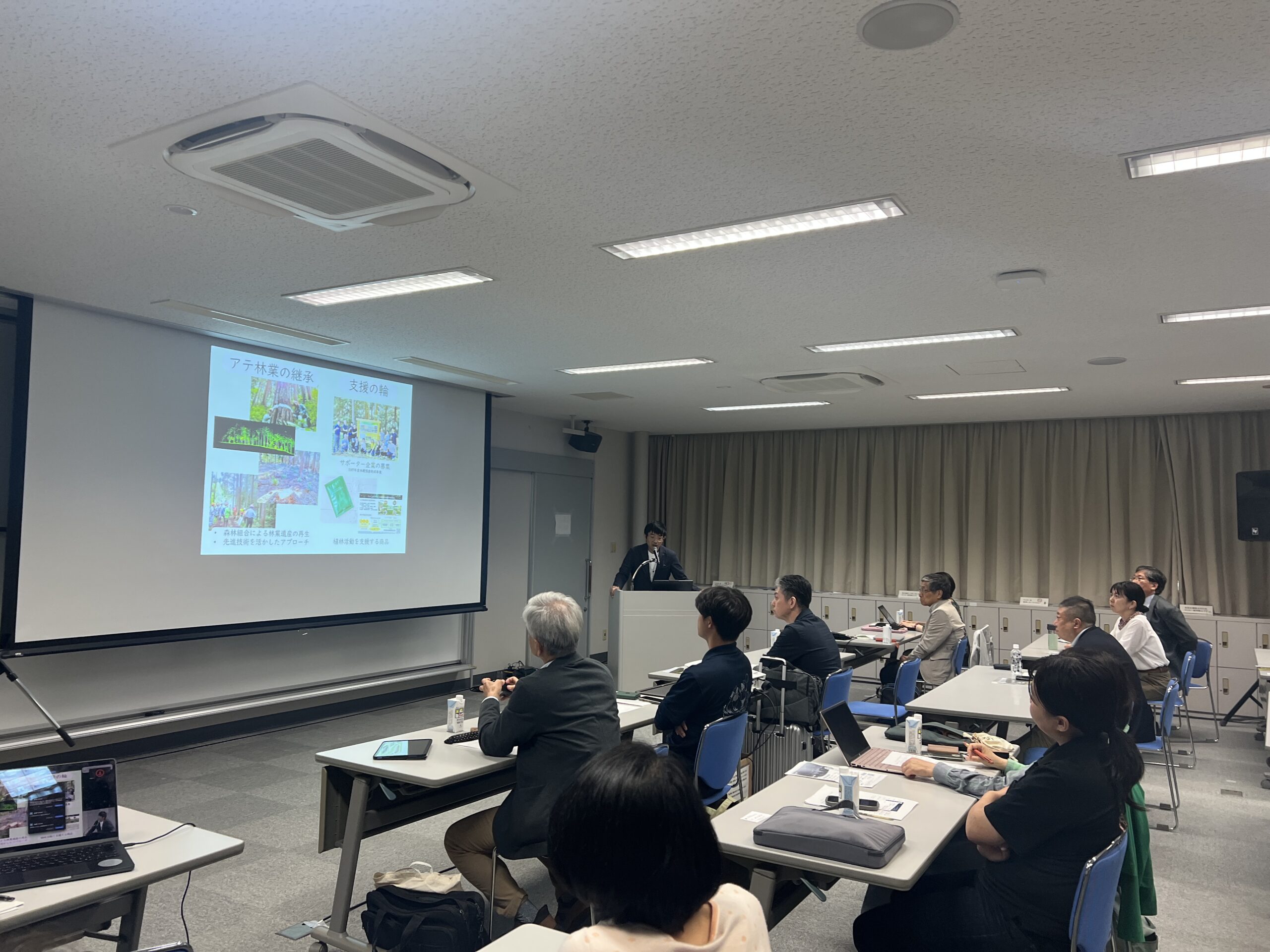
Mr. Yuho Hifumi (Ishikawa Agriculture and Forestry Research Center) introduced the topic “Forestry Heritage: Passing Down and Promoting Noto’s Ate Forestry.” He explained that Ate (Thujopsis, of the cypress family) from Noto is valued not only as durable construction timber, but also for its long-standing techniques of seedling cultivation and forest management. These practices were recognized as Forestry Heritage in 2023. He also stated that Ate is deeply connected to Noto’s culture, such as being used for the wooden bases of Wajima lacquerware and in the Kiriko festivals. At the same time, he shared the damage caused by the earthquake and stated that efforts are being made to carry on this tradition by involving people both within and outside the prefecture.
In the latter half of the event, a panel discussion, moderated by Ms. Sayako Koyama (UNU-IAS OUIK), was held on the theme “Forest Development for Creative Reconstruction: Restoration and Utilization of Forests by Diverse Stakeholders.” The panelists were Mr. Hiroyasu Takamine, Dr. Daisuke Akaishi, Ms. Atsuko Yamaguchi, Mr. Takumu Furuya, and Ms. Asako Nagano.
During the discussion, it was shared that large-scale landslides caused by the earthquake and heavy rains have affected not only forests but also the sea and fisheries through the outflow of driftwood and sediment. In addition to challenges such as restoring forest roads and planting trees in landslide areas, participants also exchanged views on emerging roles of forests, including shiitake mushroom cultivation, the circular use of forest resources, carbon neutrality, and nature-positive restoration. Furthermore, the discussion also highlighted the importance of opportunities for children to engage with nature from an early age, as well as the need to create systems that welcome people from outside the region. They emphasized the need to involve a diverse range of people in forest restoration efforts.
In the closing remarks, Dr. Tsunao Watanabe (UNU-IAS OUIK) noted that Noto has a diverse range of forests, each with its own distinct roles and uses. He emphasized that restoration efforts that make use of nature’s resilience, as well as local knowledge and remaining regional resources, will be important for future recovery. He concluded by expressing his hope that lessons from Noto could contribute to future discussions on coexistence between people and nature.
For more information, please watch the following video (recording of the symposium).