Collaborative research:アーカイブ
2018年11月26日
From November 17 to 19, 2018, the Ishikawa International Cooperation Program for Globally Important Agricultural Heritage Systems (GIAHS) was held in the Noto region of Ishikawa. Eighteen foreign exchange students enrolled at United Nations University, Kanazawa University, and Ishikawa Prefectural University from 13 countries studied rural development initiatives that make use of the site, known as “Noto’s Satoyama and Satoumi.”
This was the first study tour jointly organized and hosted by Ishikawa Prefecture, UNU-IAS and OUIK using Noto as a research field as part of a prefectural GIAHS international cooperation program. It was held as a class in the Trans-disciplinary and Graduate Research Seminar (TGRS), part of a UNU-IAS academic program, in which students conducted interdisciplinary research in one of three fields: disaster resilience, environmental education, or eco-tourism. During the program they visited Wajima, Anamizu, Nanao, Suzu, and other municipalities to observe and gain first-hand experience in, for example, tourism development utilizing local resources, efforts to utilize and pass down traditional knowledge and farming and fishing methods, and community archiving of traditional knowledge.
The presentation session on the final day became a brainstorming session as the students exchanged many ideas on ways to address the challenges facing rural communities from an international perspective. For rural Japan, which lacks human resources due to population aging and decline, such challenges share many parallels with those in other countries, and many of the students expressed a desire to make use of Noto’s approach in their home countries.
2018 saw a rise in the use of Noto’s Satoyama and Satoumi as a field for international education activities, which in one case involved hosting a delegation from Ifugao in the Philippines. OUIK plans to continue promoting the site as a center of research for sustainable development.
2018年10月28日
The 5th Conference of the East Asia Research Association for Agricultural Heritage Systems(ERAHS) was held in Wakayama Prefecture Minabe-Tanabe region, home to the “Minabe and Tanabe Ume System” which is designated as Globally Important Agricultural Heritage Systems (GIAHS), from 26th to 29th August 2018. ERAHS was established at the proposal of China on the occasion of a Japan-China-Korea GIAHS workshop organized by OUIK in 2013, which aimed at promoting exchanging academic exchanges amongst designated GIAHS site at the annual conferences which the three countries take turns to host.
UNU-IAS serves as the Secretariat of Japan, and from OUIK Secretary General of Japan Secretariat Ms. Mikiko Nagai, Research Associate Dr. Evonne Yiu and Advisor Mr. Akira Nagata also participated in the Conference this year.
Approximately 300 participants including about 100 from China and Korea participated in this 5th Conference. On the first day, Wakayama Prefecture Governor and Director General of Kinki Regional Agricultural Administration Office graced the opening ceremony, and Prof. Kazuhiko Takeuchi, Senior Visiting Professor of UNU-IAS spoke on “Partnership with GIAHS” along with the FAO GIAHS (Scientific Advisory Group SAG) Vice-Chairperson and FAO GIAHS global coordinator gave the keynote presentations. Parallel discussions were then held in four sessions with themes on tourism, succession of GIAHS to the next generation, branding, and participation of multi-stakeholders. Following which, keynote presentations were also made by agriculture ministry’s representatives of Japan, China and Korea, then a reporting session on parallel sessions and finally a closing ceremony. On the second day, the participants made field visits to Wakayama prefecture Ume research center, Minabe town Ume promotion center, Kishu-Ishigami Ume Forest in Tanabe city, Kishu-Bincho charcoal memorial park etc. On the third day, two thematic sessions on monitoring and evaluation of GIAHS and biodiversity conservation were also held.
In particular, this ERAH conference has emphasized and showcased the activities of young people such as university (graduate) students and regional cooperation youths. Suggestions such as creating a GIAHS youth network and a special group meeting by young people at the next ERAHS conference were also proposed. Also, exchange between domestic and foreign GIAHS designated sites was also active. It is expected that these exchanges and knowledge shared will be utilized to revitalize the rural area through the conservation of GIAHS.
The next ERAHS will be held from 19th May (Sunday) to 22nd (Wednesday) 2019 at the GIAHS site of Hadong (tea cultivation system) in Korea.
2018年07月10日
4th booklet by OUIK’s biocultural diversity study has been published.
[Learning about the Sastoyama and Satoumi of Hokuriku Region from Maps]
2018年07月08日
6th workshop on Japanese garden and eco-system services has been organized at Shinrensha temple, Kanazawa city. The workshop report is available.
2018年07月08日
On 24th June, a workshop of ‘Spiritual Road Walking and Garden Cleaning at Shinrensha Temple’ was held within Utatsuyama Temple Area in Kanazawa City, which was proposed by Dr. Juan Pastor Ivars, a research associate of the OUIK. (Hosted by: UNU-IAS OUIK, and supported by: Shinrensha Temple and Kanazawa City)
The series of workshops started last year and this sixth workshop was a big success with nearly 30 people taking part, well over the initial quota of 20 people.
There are increasing number of untended Japanese gardens
Japanese gardens can be found in urban areas and they produce biodiversity and provide numbers of ecosystem services including relaxation to the residents. This workshop is a part of a project to build a system where the Japanese gardens in Kanazawa City, which still exist in large numbers, can be maintained and managed for a long time to come. Primarily, gardens are supposed to be managed by their owners. However, due to aging of the owners, more and more gardens are becoming untended every year. Cleaning is important not only to restore the beauty of the gardens and urban landscape but also to conserve ecosystems and maintain biodiversity.
In order to conserve Japanese gardens that are designated as cultural properties by Kanazawa City, Dr. Juan holds this workshop where overseas students, foreign tourists, and local residents help cleaning the gardens and in return, they get the opportunity to attend a tea ceremony with a beautiful view of the garden or to study about gardens from various experts. In repetition, the number of participants is increasing and making a tangible impact as a new system of garden management in the city.
Precious opportunity of tending the gardens
On the day of the workshop, participants gathered at Utasu Shrine near Higashi Chaya District and walked along the Spiritual Road that winds through Utatsuyama Temple Area. As they made their way to Shinrensha Temple, they observed hollowing out of city center, i.e. vacant houses and land, and the impact of rapid tourism expansion.
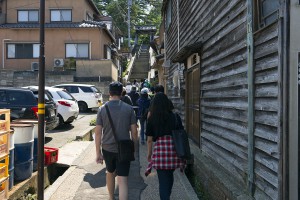
take a walk along the spiritual road
The garden of Shinrensha Temple was created in early Edo period. It is a Tsukiyama Chisen-style shoin garden having a pond at the center and small artificial hills at the back. The garden also makes use of the landscape created by surrounding trees that are preserved by Kanazawa City.
First, the chief priest of the temple explained the history of the garden and a specialist of landscape architecture gave a lecture on garden management. Then, the cleaning activity started. Participants were divided into three groups to clean up different areas: artificial hills, pond, and moss area in front of the pond. Although the garden looked clean at first sight, a large amount of fallen leaves had piled up at the bottom of the pond and was turning into sludge. Taking out fallen leaves from a pond is hard work and require a lot of manpower. Young university students and overseas students showed excellent work here. Cleaning the artificial hills and the grave yard behind them was also a hard task as they were extensive. However, because we had a large number of participants this time, we divide the roles and cleaned them up quickly.
Several species of moss, such as haircap moss, grow thickly in front of the pond and show very beautiful atmosphere. However, when some parts of the moss were carefully taken off, exquisite paving stones of Tomuro-ishi appeared. In a former workshop, garden path of cobblestones called ‘ararekoboshi’ was restored in the same way. This kind of work require caution and cannot be thoughtlessly carried out without the knowledge of landscape architecture. For this workshop, we did not have to worry about this as we had several notable landscape architects. It is a valuable experience to touch Japanese gardens while learning various things from garden specialists.
After the cleaning activity, everyone relaxed with Japanese sweets and drinks gazing at the garden, experienced Japanese tea ceremony, and took a look back over the day.
Management of Japanese gardens in an enjoyable and sustainable way
Participants included students from universities within Ishikawa prefecture, overseas residents within the prefecture, and people from Kanazawa City Office. Participants had different motivation for joining the workshop. Some liked Japanese gardens, some wanted to walk the Spiritual Road, and some were moved by the sight of Dr. Juan, a Spanish man, taking care of Japanese gardens. One participant said that he got interest because he would be able to touch a precious garden. He says he feels a stronger bond with the garden after taking part in the workshop. It was also a first time for Dr. Juan to step into a garden pond this time. He says the excitement he felt at that moment is unforgettable. On the other hand, by having so many participants to a workshop like this, owners of the gardens recognize the value of their garden once again.
Dr. Juan is hoping to develop this workshop as ‘ecotourism’ in which tourists and disabled people can take part and gradually take root as a new garden management system.Being linked with SDGs goals 11 ‘Sustainable Cities and Communities’, 15 ‘Life on Land’, and 17 ‘Partnership for the Goals’, this activity will continue to be expanded as a model of sustainable cooperative management of gardens in the city.
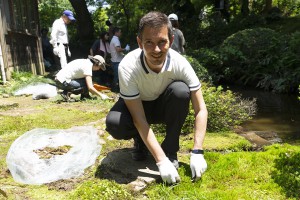
Dr. Juan Pastor Ivars
In August, this workshop is going to be held at Honsenji Temple in Futamata-machi, Kanazawa City. Please take part in the workshop.
2018年04月02日
2018/4/2, Hakusan
Report on the International Workshop Shiramine 2018: “University Education for Mountain UNESCO Eco-Parks Created with Diverse Stakeholders”
Date: March 31, 2018 (Saturday) 14:00 – 16:30
Location: “Yohei” – a traditional farmhouse built in the Edo period (NPO Shiramine Nature School)
Co-Organizers:
- United Nations University Institute for the Advanced Study of Sustainability, Ishikawa-Kanazawa Operating Unit (UNU-IAS OUIK)
- NPO Shiramine Nature School
- Hakusan UNESCO Eco-Park Council
- Kanazawa University International Institute
Cooperation: Ishikawa Prefectural Hakusan Nature Conservation Center
The International Workshop Shiramine 2018 was held with a total of 24 participants, featuring Scottish mountain researcher Martin Price (who visited Japan from March to April 2018 as a Short-Term Foreign Research Fellow from the Japan Society for the Promotion of Science, hosted by the Tsukuba University Mountain Science Center).
14:00-14:10 Introduction (Venue Explanation)
At the beginning of the workshop, the coordinator, Yoshihiko Iida from the UNU-IAS OUIK, provided an introduction to the workshop’s purpose. He raised the question of how to develop human resources activities (especially university education), which is one of the three functions of UNESCO Eco Parks, in collaboration with various stakeholders. Following this, Mr. Takashi Yamaguchi from the co-hosting organization, the Shiramine Nature School, introduced the venue, “Yohei,” a traditional house built in the Edo period, along with the activities of the nature school.
14:10-14:50 Mini Lecture: “Introduction to Scotland’s UNESCO Eco-Parks and Activities of the University of the Highlands and Islands”
Martin Price (Professor at the University of the Highlands and Islands) presented examples of Scotland’s UNESCO Eco-Parks, including the Galloway and Southern Ayrshire UNESCO Biosphere, which supports branding for livestock and fishery products using local logos, and the Wester Ross UNESCO Biosphere, designated for its integrated mountain and coastal landscapes.
Additionally, there was an introduction to the University of the Highlands and Islands, which is a unique institution in the UK. It operates as a partnership of 13 institutions, including nine vocational training colleges and three specialist training schools in fisheries, Celtic culture, and theology, as well as a marine science research center. The university primarily conducts online distance education programs, with most students coming from Scotland, including many working professionals aged 30 and over. Research is also being conducted focusing on the Wester Ross UNESCO Biosphere. From 2017 to 2020, with support from the EU, a project promoting sustainable ecotourism was implemented in collaboration with sites in Scotland, Norway, Finland, Iceland, and Greenland.
14:50 – 15:50: Case Presentations
To provide insights from the Hakusan Tedorigawa UNESCO Global Geopark, Ms. Erika Takasaki (Secretary of the Hakusan Tedorigawa UNESCO Global Geopark Council) introduced its characteristics, history of registration, and operational structure, as well as network activities with UNESCO Eco-Parks and affiliated entities domestically and internationally.
Next, Mr. Norimasa Toga, presented on the initiatives of the Ishikawa Prefectural Hakusan Nature Conservation Center, explaining the overview of alpine zone monitoring conducted as part of the Ministry of the Environment’s Monitoring Site 1000. He also highlighted wildlife monitoring activities conducted at the Bunao Mountain Observation Building since 1981, as well as volunteer collaboration efforts for invasive plant removal and monitoring changes since 2004. Mr. Koji Ogawa then shared the long-term monitoring activities of the snowfield at Senjagaike on the summit of Mount Hakusan, ongoing since 1981, showcasing changes over the years.
Ms. Aida Mamadova (Kanazawa University International Institute) introduced Kanazawa University’s regional learning initiatives conducted at the International Center since 2015, discussing the significance of education from the perspective of biocultural diversity and the outcomes of student education in a camp format within local communities. She noted that while international students show significant interest, Japanese students tend to show less engagement, presenting this as a challenge. Additionally, the status of four UNESCO Eco-Parks in Russia was introduced, along with future plans for student exchange programs with Russia.
15:50 – 16:30: Discussion
In the discussion session, participants aimed to deepen interaction. Representatives from the Ministry of the Environment’s Hakusan Conservation Office, NPO Kan Hakusan Protection and Management Association, Tsukuba University Mountain Degree Program, Kanazawa University Noto Campus (Noto Satoyama Satoumi Meister Training Program), Mie University Future Earth program, Hakusan Tedori River Geopark Promotion Council, and Aeon Environmental Foundation shared brief overviews of their activities and comments related to university education, the theme of the workshop.
Participants expressed that university education plays a significant role as an entry point for understanding nature conservation efforts and local realities, along with expectations for universities as research institutions. The presence of university representatives from Tsukuba, Kanazawa, and Mie universities underscored the importance of grassroots connections between universities across regions.
Finally, Mr. Hiromasa Yamashita (Secretary General of the Hakusan Tedorigawa UNESCO Global Geopark / Secretary General of the Hakusan Tedori River Geopark Promotion Council) delivered closing remarks as a co-organizer.
We would like to extend special thanks to Mr. Daniel Heliot (Coordinator for International Relations, City of Hakusan) for his exceptional assistance with interpreting for Martin Price throughout the event.
Report by: Yoshihiko Iida (Research Associate, UNU-IAS OUIK / Advisor to the Hakusan UNESCO Eco-Park Council)
2018年03月21日
2018/3/21
An article by researcher Evonne Yiu on the Noto Satoyama Movement has been published in Issue 423 of the “Ocean News Letter” from the Ocean Policy Research Institute.
2018年01月25日
The Booklet presents the value and history of GIAHS through the cases and reports from Japan and East Asia. Available from publication page
2017年11月28日
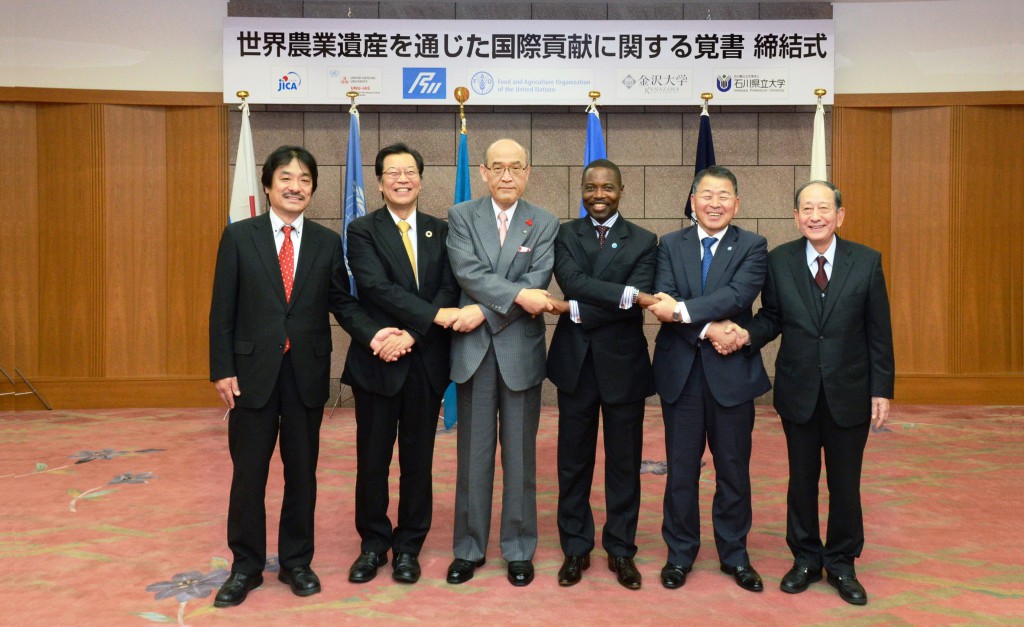
On November 20, 2017, Ishikawa Prefecture, Kanazawa University, Ishikawa Prefectural University, Food and Agriculture Organization of the United Nations (FAO), JICA Hokuriku Branch Office, and the United Nations University Institute for Advanced Study of Sustainability (UNU-IAS) signed a memorandum on ‘International Cooperation Through GIAHS in Ishikawa Prefecture”
‘Noto’s Satoyama and Satoumi’ which stretches over nine municipalities in Noto Peninsula of Ishikawa Prefecture was designated as one of the Globally Important Agricultural Heritage Systems (GIAHS) in 2011 together with Sado Island. They were the first designations from developed countries. Since then, United Nations University has been carrying out various activities together with Ishikawa Prefecture, nine municipalities, and local people of the region. At the GIAHS International Coference 2013 , it was suggested to strengthen the cooperation between the GIAHS in developed countries and those in developing countries by Noto Communiqué. In the following year, 2014, Ishikawa Prefecture established a training program thorough which participants can learn about conservation and utilization of Noto’s Satoyama and Satoumi and its regional development. It has accepted trainees from six different countries so far, including Bhutan, Indonesia, and Laos.
This program has just taken a step further. An international cooperation program was established to bring about mutual-leaning: to enable trainees from developing countries to learn ‘sustainable regional development’ in Noto’s Satoyama and Satoumi on site; and also to enable people in Noto region to realize the global values of sustainability thorough their contribution to this training program. FAO, JICA Hokuriku Branch Office, Kanazawa University, Ishikawa Prefectural University, Ishikawa Prefecture, and UNU-IAS have joined the program as implementing bodies.
2017年10月09日
On 30 August 2017, OUIK and several organizations, including Junior Chamber Kanazawa (JC Kanazawa), Kanazawa Institute of Technology (KIT), and Hokuriku Branch Office of Japan International Cooperation Agency (JICA Hokuriku), signed a memorandum of understanding to set up a framework to support private sector contributions towards achieving Sustainable Development Goals (SDGs).
At the signing ceremony, the parties to the agreement spoke enthusiastically about creating further opportunities to achieve SDGs through collaboration. Mr. Tsunao Watanabe, the OUIK director, stated that he expects this agreement to be a driving force that will move the world towards sustainability via a new SDGs-themed public-private-academic partnership.
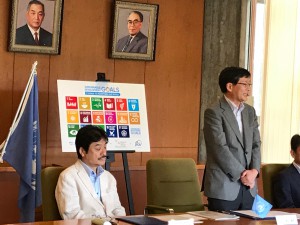
Mr. Watanabe said “OUIK will contribute in order to build local platform for the dialogue among different sectors
OUIK, along with JC Kanazawa, KIT, and JICA Hokuriku, will begin to utilize this new public-private-academic partnership to eventually lead to the promotion of sustainable businesses on a national and worldwide scale.
Related link:
Kanazawa Institute of Technology
Junior Chamber Kanazawa
Japan International Cooperation Agency