
From 17 to 23 October 2026, Dr. Juan Pastor-Ivars took part in the 22nd General Assembly and Scientific Symposium of the International Council on Monuments and Sites (ICOMOS), held at the Borneo Convention Centre in Kuching, Sarawak. Around 1,500 heritage professionals from more than 130 countries took part. They met in the statutory meetings of the General Assembly, which set ICOMOS’s direction for the coming years, and in the Scientific Symposium, under the theme “Living Heritage: Respect, Enhance, Accept, Partnership.” Keynote lectures on the first day of the Symposium, 19 October, framed heritage as a living, community-embedded process.
Dr. Pastor-Ivars gave two presentations based on the abstract “Enhancing Urban Heritage Ecosystems: Japanese Gardens as Socio-Ecological Model Systems. Evidence from Kanazawa,” drawing on OUIK’s Sustainable Urban Nature (SUN) project. Both presented evidence of the gardens’ benefits for biodiversity, carbon storage and wellbeing.
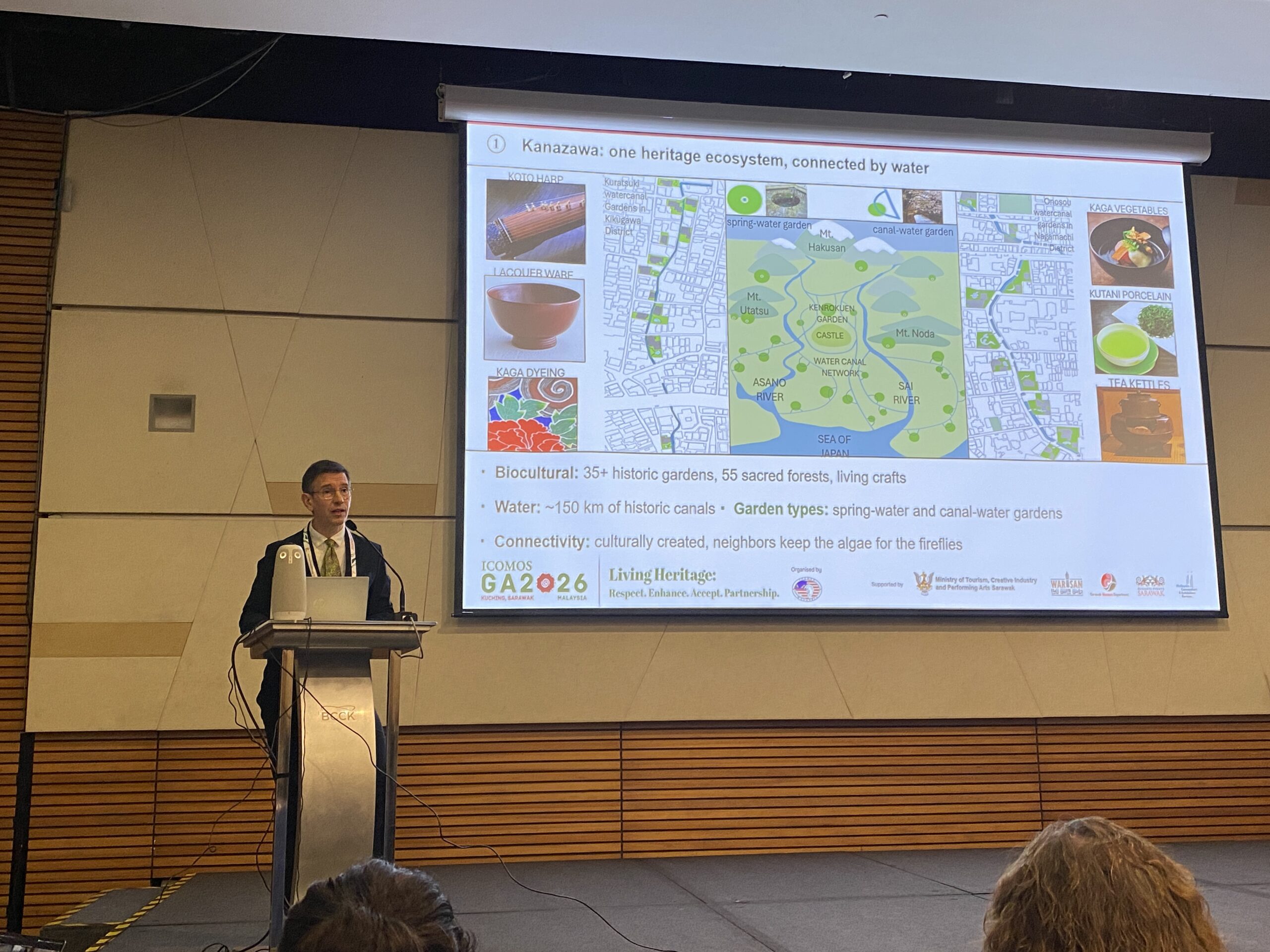
On 20 October, in the sub-theme Enhance, he showed how caring for historic gardens together strengthens both the gardens and the communities around them, through joint maintenance, firefly surveys with children, eco-tourism and community gardens on vacant plots. On 21 October, he presented in Session 9, “Heritage Ecosystems: Possibilities and Potentials for an Inclusive Systems Approach,” organised by several ICOMOS scientific committees and ICOMOS Japan. The session built on the Gunma Declaration on Heritage Ecosystems (2025), https://icomosjapan.org/media/Gunma_Declaration_on_Heritage_Ecosystems_2025_ENG_Sv9UtWC.pdf which calls for overcoming the divisions between cultural and natural heritage and recognizing more-than-human rights-holders. Dr. Pastor-Ivars presented the framework treating each garden and its custodian as a single socio-ecological system, assessed through four capacities: habitat, connectivity, biocultural continuity and resilience.
The heritage ecosystem approach fits naturally with Kanazawa. In the city, historic gardens, some 150 km of historic canals, sacred forests, traditional crafts and the species that inhabit them have evolved together. This biocultural diversity, recognized in Kanazawa’s Biocultural Diversity Strategy (2016) and at the heart of OUIK’s work, offers a living example of how cultural and natural heritage can be understood and cared for as one system.
Participants responded very positively to the presentations. They showed particular interest in reading gardens and their custodians as one system, in the role of canals as culturally created connectivity for wildlife, and in the participation of children and citizens in caring for private heritage. Several noted that Kanazawa offers a concrete and transferable model of the heritage ecosystem approach in an urban setting.
Participation in the General Assembly allowed OUIK to share the Kanazawa model of urban nature with the international heritage community. It also strengthened ties between ICOMOS and UNU-IAS, and opened possibilities for future collaboration and comparative studies.