
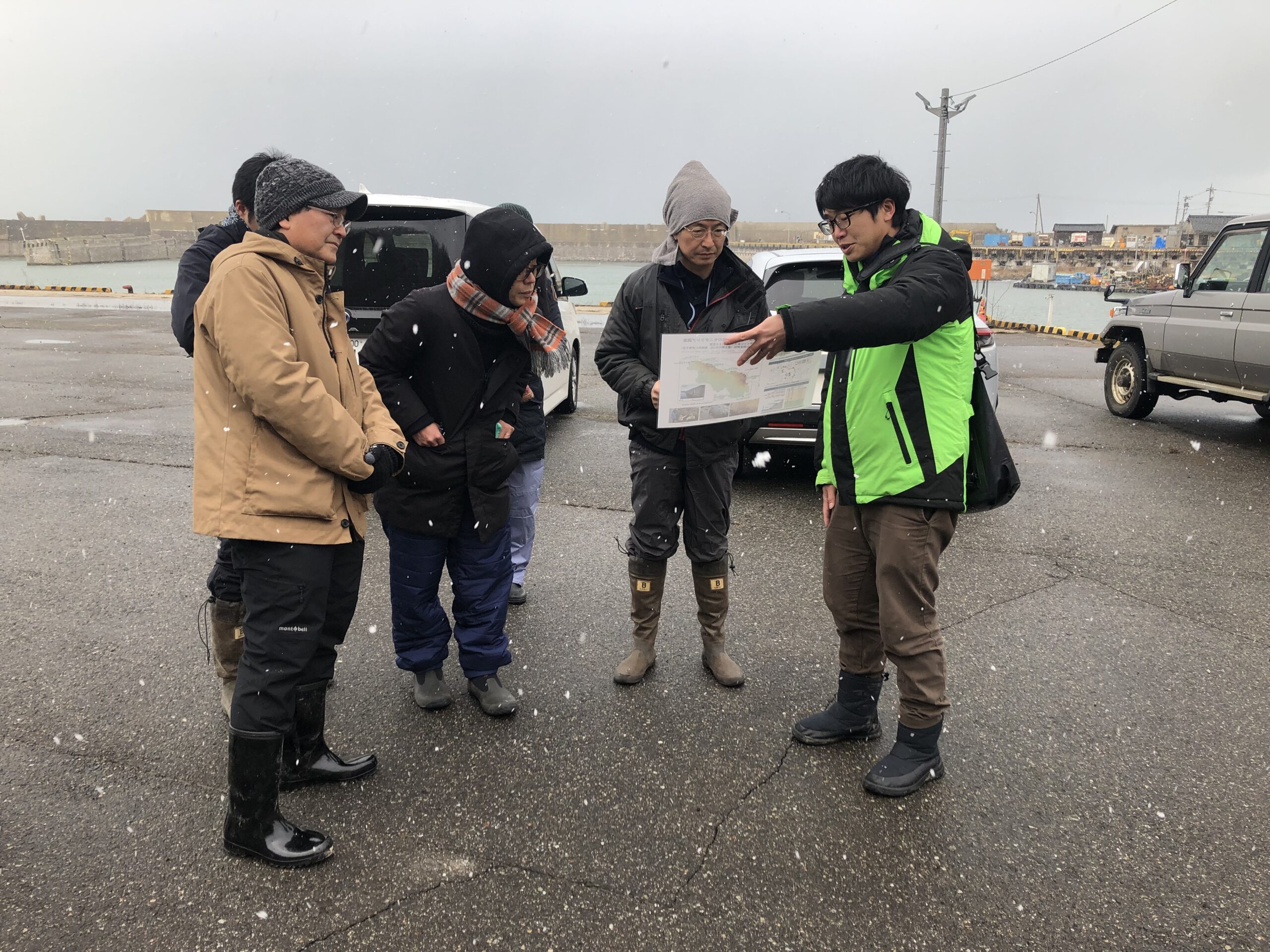
From January 14 to 15, 2026, the UNU‑IAS OUIK, together with experts from the National Institute for Environmental Studies (NIES), visited the Noto Peninsula to observe natural sites affected by the earthquake and heavy rainfall, including uplifted coastlines and landslide-affected areas.
The field visit was conducted by seven participants:
Dr Jun Nishihiro (Deputy Director, Center for Climate Change Adaptation, NISE), Dr Satoshi Onishi (Senior Researcher, Fukushima Regional Collaborative Research Center, NISE), Dr. Wataru Hotta (Researcher, Center for Climate Change Adaptation, NISE), Dr Tsunao Watanabe (Visiting Research Fellow, UNU-IAS OUIK), Ms. Sayako Koyama (Researcher, UNU-IAS OUIK), Ms. Yoko Tomita (Programme Coordinator, UNU-IAS OUIK), and Dr. Hideki Kobayashi (Assistant, UNU-IAS OUIK).
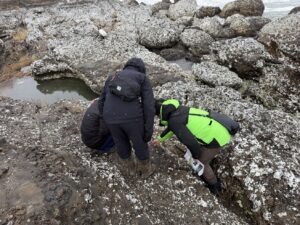
On the first day, guided by Dr Hiroaki Arakawa of the Noto Marine Center, the team visited uplifted coastal and riverine sites. In Kaiso, Wajima City, which the team visited in the morning, they inspected one of the sites where the largest coastal uplift from the recent earthquake was recorded and received an explanation about the outline of the rocky shore surveys and the impact of the uplift on intertidal organisms. It was winter weather typical of Noto, with cold, strong winds blowing across the area, and the group was able to observe sea foam locally called “nami-no-hana (wave flowers)”, a well‑known winter phenomenon in the northern part of Noto.
In the afternoon, the group moved to the area near the mouth of the Machino River, where they visited sites where the river course had shifted due to uplift, with explanations from local residents. They also visited the wetlands in the lower reaches of the Machino River, where Dr Arakawa explained the current conditions. At each site, it was noted that the lowering of water levels caused by the uplift had created drops at the confluence points between tributaries and the main river, and that improvements to drainage channels and similar works could potentially affect the surrounding environment, with such impacts already observable in some areas. The participants shared the understanding that conserving the ecosystem, including its rare species, is an important consideration alongside recovery efforts, and lively discussions were held on site regarding the necessary directions for environmental management.
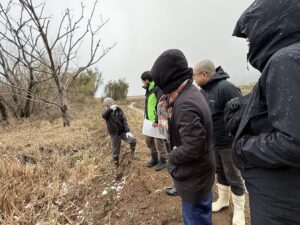
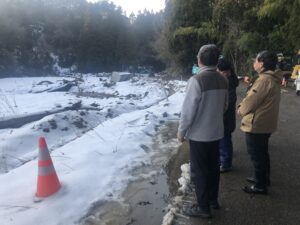
On the morning of the second day, Professor Seiji Yanai of Ishikawa Prefectural University guided the group through a landslide-affected site in Wajima City, where a large‑scale slope failure had occurred as a result of the earthquake. With explanations from a local official, the group examined the condition of the temporary channel that had been constructed to address the river blockage caused by the large volume of collapsed earth and debris. They also spoke about the importance of planning restoration efforts in accordance with the geological and topographical characteristics of each landslide zone. At the site of the large-scale collapse, the group witnessed firsthand the extent of the damage and the ongoing restoration work.
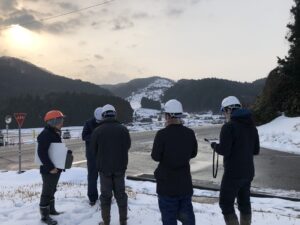
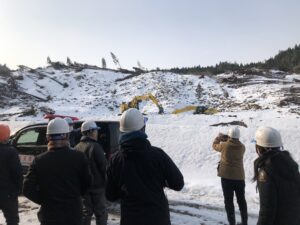
The group then traveled to Suzu City, where Professor Yanai, who leads the post-earthquake Mitsukejima Island Survey Project Team, explained the island’s formation and geological characteristics, as well as the changes in its shape and vegetation following the disaster. While much of the soil had collapsed and much of the vegetation had been lost due to the earthquake, it was noted that signs of recovery could be seen not only in the remaining vegetation but also in fallen trees.
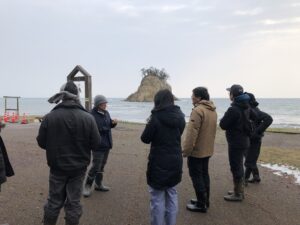
In the afternoon, Dr. Daisuke Utsunomiya of the Suzu City Office guided the group to rice fields in the city that had been damaged by the disasters. They first visited fields involved in habitat restoration efforts to support the reintroduction of the crested ibis, where they received explanations about post-disaster drainage measures and the creation of habitats where living organisms can thrive. The participants also exchanged views on the potential use of former irrigation ponds, waterways, and other previously utilized infrastructure.
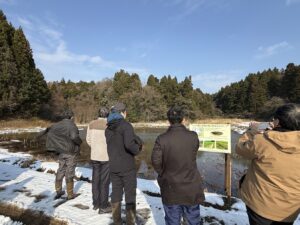
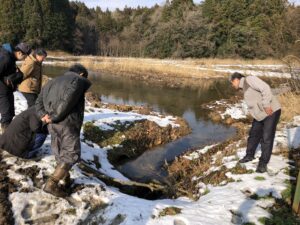
Finally, the group visited fields inundated with sediment after rivers overflowed during the Oku-Noto heavy rains of September 2024, which followed the earthquake. Even now, fallen trees washed down from the mountains during the storm remain at the site, underscoring once again the scale of the damage. In addition to the long time required for restoration, the participants also shared the understanding that, amid social changes such as population decline, restarting local livelihoods themselves may become a major challenge.
During this field visit, the group observed a wide range of cases related to post-earthquake changes in the natural environment. Going forward, it will be essential to accurately track these changes through monitoring, nurture the signs of regeneration and resilience seen across sites, and present options for restoration and conservation. The visit reaffirmed among the participants that environmental conservation should contribute to building a sustainable local society.