
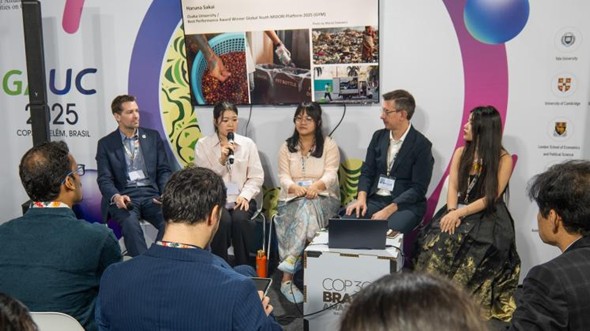
On 17 November 2025, at a side event during UNFCCC COP30 in Belém, “Fostering Sustainability Science Leadership: Synergies for Bridging Capacities Across Environmental and Developmental Policy Agendas” was held at GUAC Pavilion. This event highlighted the institute’s approach to drive synergies across biodiversity, climate and culture through integrated education, research and youth empowerment initiatives. The event was co-organized with the UNU-IAS and the Global Alliance of Universities on Climate (GAUC).
Dr Juan Pastor-Ivars (Research Fellow, UNU-IAS OUIK) presented OUIK’s work connecting biodiversity, climate and culture through integrated research and youth empowerment. He highlighted the initiatives of the UNU-IAS Operating Unit Ishikawa / Kanazawa (OUIK), including the Sustainable Urban Nature (SUN) project and its youth empowerment program engaging high school students. Dr Juan emphasized how OUIK builds bridges between local knowledge, cultural values and global policy discussions, notably through collaboration with UNEP’s #GenerationRestoration initiative and Kanazawa City. He underscored the importance of international cooperation to scale up local innovations and strengthen momentum for nature-based solutions.
Other contributions included short interventions from two Global Youth MIDORI platform (GYM) | United Nations University (GYM) speech contest winners, who reflected on challenges in sustainability education, youth engagement and sponge city initiatives, calling for stronger support systems for young practitioners.
Moderated by Nicholas Turner (UNU-IAS), the discussion concluded that long-term community engagement, project continuity and meaningful youth leadership are key to overcoming capacity gaps and advancing effective, cross-cutting sustainability solutions.