Collaborative research:アーカイブ
2017年09月26日
Dr. Yoshihiko Iida participated in the 7th training workshop of the East Asian Biosphere Reserve Network (EABRN) (cover photo provided by MAB National Committee of the Republic of Korea).
A workshop titled ‘Biodiversity Infomatics in Big Data Era’ was held in Institute of Botany, Chinese Academy of Sciences (IBCAS) from September 4 (Mon.) to 9 (Sat.), 2017. 47 participants from 17 Asian countries (Uzbekistan (1), Tajikistan (2), Kazakhstan (2), Mongolia (2), Pakistan (3), India (1), Bangladesh (1), Sri Lanka (1), Philippines (3), Thailand (2), Vietnam (3), Nepal (2), Malaysia (1), Indonesia (1), South Korea (6), China (15), and Japan (1)) participated in the workshop.
The training course started with a lecture from Prof. Keping Ma (the Institute of Botany, Chinese Academy of Science) on the importance of information sharing on biodiversity conservation and monitoring particularly based on the field of taxonomy at Asian scale. More than 10 researchers from the institute provided lectures of more specific information on the topic. Through these lectures, participants learnt various methodologies to build specimen database utilizing the internet and to monitor animals and plants in forest areas with IT and remote sensing techniques. In addition, participants visited a long-term forest ecosystem monitoring site to understand and learn from the practical methods in the field. On September 9 (Sat.), Mr. Qunli Han, the former director of the Division of Ecological and Earth Sciences of UNESCO, gave a lecture on various efforts related to UNESCO Biosphere Reserves at global scale.
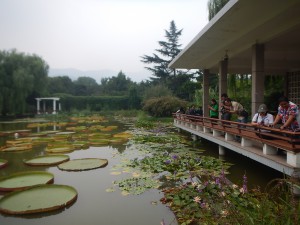
Botanical garden at Institute of Botany
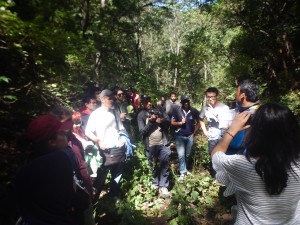
Introduction of research activities at the long-term forest ecosystem monitoring site in Beijing (Donglingshan 20-ha forest dynamic plot)
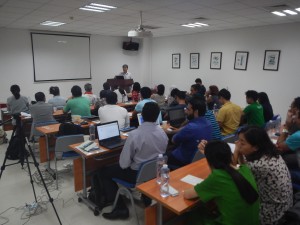
Lecture on UNESCO Biosphere Reserves from Mr. Qunli Han
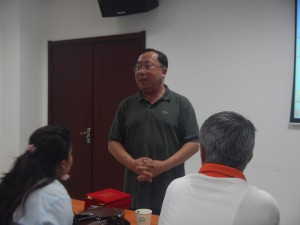
Greeting from Prof. Keping Ma to participants
The second half of the 7th EABRN workshop was held in South Korea from September 11 (Mon.) to 14 (Thu.), 2017. Seven people from four countries (Russia (2), Kazakhstan (2), Mongolia (2), and Japan (1)) participated and visited Gwangneung Forest Biosphere Reserve (GFBR) and Mount Sorak Biosphere Reserve (MSBR) in the northern part of the country (hosted by: MAB National Committee of the Republic of Korea and UNESCO Beijing Office). In the GFBR, together with local citizens, participants learnt about the current condition and measures against pine wilt disease and oak wilt disease in the forest reserve. In the MSBR, after listening to the explanation on the outline of the National Park’s governance and visiting a visitor center and a National Herbarium, the participants understood their various activities on wildlife (such as insects and mammals) protection, conservation, and monitoring in practice. They also visited related field sites. The efforts of protecting and conserving Korean goral species (closely related to serow) in the MSBR (implemented by Species Restoration Technology Institute, Korea National Park Services) were well explained. During the discussion, Dr. Iida pointed out about a case of wildlife damage in Japan similar to problems occurring in South Korea. It was recognized that wildlife management was a common issue for both countries. Furthermore, the activity of “Citizen College” at MSBR was introduced as the best practice that has contributed to connect the citizens with the Biosphere Reserve, through its course and alumni network.

Insect monitoring site in a forest plot (photo: MAB National Committee of the Republic of Korea)
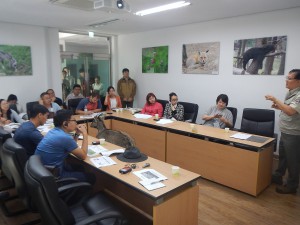
Explanation about the goral conservation activities being carried out by Species Restoration Technology Institute, Korea National Park Services, in Mount Sorak Biosphere Reserve
This international workshop and attendance of the participants were fully supported by UNESCO Beijing Office.
2016年05月20日
2016/5/11
On May 11, 2016 (Wednesday), a publication commemorating the Biological and Cultural Diversity Series #2 titled “Hakusan Biosphere Reserve– A Community Future Woven by People and Nature” was held as an event.
Noëline Raondry Rakotoarisoa from UNESCO Headquarters (Paris, France), Chief of the MAB Networking Section of the Ecological and Earth Sciences Division, visited the United Nations University Institute for the Advanced Study of Sustainability (Shibuya, Tokyo) and spoke at the international symposium titled “Learning through a Global Network and Conservation of Biological and Cultural Diversity – Insights from the UNESCO Eco-Park Cases.”

Left: Kazuhiko Takemoto, Director of the IAS; Center: Noëline Raondry Rakotoarisoa; Right: Tsuneo Watanabe, Director of IAS-OUIK
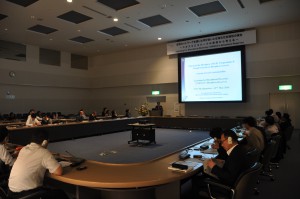
During the event, she exchanged views with practitioners from eight UNESCO Biosphere Reserves across Japan on how Japan can contribute to learning with the world.
At the symposium, Yoshihiko Iida, a researcher from OUIK, presented on “Approaches for Learning with the Global Network – Goals of the United Nations University OUIK Booklet ‘Hakusan UNESCO Biosphere Reserve’.”
Additionally, Shinsuke Nakamura (a member of the Japan UNESCO Biosphere Reserve Network Operating Working Group and Secretariat of Hakusan Biosphere Reserve Council) provided insights on “Connecting with Global UNESCO Biosphere Reserves – Contributions from the 4th World Congress of Biosphere Reserves”
The cooperative efforts of the United Nations University OUIK and local stakeholders in the UNESCO Biosphere Reserves were shared as case studies.
During her first visit to Japan, Ms. Raondry Rakotoarisoa commented that the experiences of Japan’s UNESCO Biosphere Reserves provide valuable lessons for the global network.
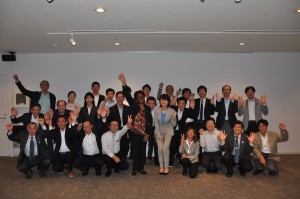
(Author: Yoshihiko Iida)
2017年07月04日
The UNU-IAS Operating Unit Ishikawa-Kanazawa (OUIK) organized a symposium entitled “A Look at the Various Work Supporting Satoumi Creation” on June 10, at UNU Headquarters in Tokyo to commemorate the publication of the third volume in its Biocultural Diversity Series “Noto Satoumi Movement: Passing on Wisdom of Living with the Sea”. This symposium was held in conjunction with the UN “World Ocean’s Day” on June 8 and “The Ocean Conference” held at UN Headquarters in New York from June 5 to 9. Attended by 80 over participants, it was the first time a symposium solely themed on “Satoumi” was held at the UNU headquarters.
After the opening remarks by UNU-IAS OUIK Director Mr. Tsunao Watanabe, Senior Visiting Professor Kazuhiko Takeuchi delivered the keynote presentation on “A look at the Forest-Land-River-Sea connection in Noto’s Satoyama and Satoumi”, followed by report from UNU-IAS OUIK Research Associate Ms. Evonne Yiu on “OUIK’s Noto Satoumi Movement”. In the session on the “’Jobs in Noto’s Satoumi” included presentations by Fisher/Chairman of Ninzaki-Shigaura District Satoumi-Satoyama Promotion Council Mr. Masaki Iwata on reviving traditional mullet watchtower fishing in Anamizu town; Promotion Supervising Chief, Ishikawa Prefecture Fisheries Research Center, Mr. Takahiko Ikemori on his research of the seaweeds in Noto; Academic teacher, Japan Aviation High School Ishikawa Campus, Mr. Mizuki Suhara of Japan Airlines High School on supporting satoumi creation through scuba-diving, as well as a talk session between Chariman of Wajima Women Skin Diver Fishery Conservation Promotion Association, Ms Sachiyo Ikezumi and OUIK Research Associate Ms. Evonne Yiu.
In the session showcasing best practices of satoumi creation from other parts of Japan, NPO Satoumi Creation Research Meeting Executive Director Mr. Takahiro Tanaka introduced the “Regeneration of seagrass beds and oyster cultivation in Hinase, Okayama prefecture ” and Design · Bar Representative Mr. Akihiro Dazai from Minami Sanriku Town of Miyagi prefecture spoke on the “Recovery from the Great East Japan Great Earthquake Town through Forest-Land-Sea-People approach”. At the panel discussion moderated by OUIK Director Mr. Tsunao Watanabe Tsunao, Professor Nobuyuki Yagi Professor of the University of Tokyo Graduate School of Agricultural and Life Sciences gave his comments on the significance of the Satoumi concept in addressing international ocean issues, and also saw speakers and participants engaged in active discussions, including clarifications on how to define Satoumi and how Satoumi creation can be implemented.
The symposium emphasized the necessity to create a mechanism in Japan’s satoumi, whereby traditional fishing methods and customary practices of resource management could be capitalized, along with managing fisheries resources and coastal areas as open commons suited for needs of the modern society. Also, it is recognized that by conserving the bountiful natural marine environment as typified by Satoumi concept, could also contribute to the international community’s effort in achieving of the “Sustainable Development Goals (SDGs)” (in particular SDGs 14).
2017年08月06日
2017/7/13, Huzhou, China
Participants from OUIK attended the 4th Meeting of East Asian Research Association for Agricultural Heritage System (ERAHS) held from July 12 to 13 in Huzhou, Huzhou, China.
The ERAHS conference brings together designated regions of world agricultural heritage from China, South Korea, and Japan to exchange knowledge on conservation and utilization, marking its fourth edition this year. This year’s theme was “Promoting the Conservation of Agricultural Systems through Industrial Transformation.” Presentations were made from various regions focusing on improving scientific communication regarding agricultural heritage systems, sharing best practices and case studies among different cultural heritages, and promoting collaboration on agricultural heritage systems among East Asian countries.
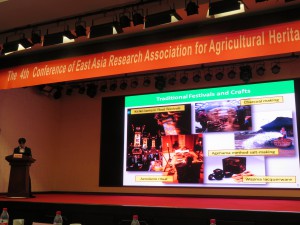
Specialist Nagamori from Ishikawa Prefecture presented on the utilization of Noto GIAHS (Globally Important Agricultural Heritage Systems)
Following keynote speeches by Professor Luo Shiming (South China Agricultural University), Kazuhiko Takeuchi (Senior Fellow, United Nations University), and Professor Mauro Agnoletti (University of Florence), parallel sessions were conducted on topics including: 1) Branding for Regional Economic Development, 2) Motivating the Conservation of Agricultural Biodiversity and Ecosystem Services, 3) Sustainable Tourism, and 4) Innovative Mechanisms for Preserving Local Culture.
From OUIK, Researcher Iida presented a poster on “Current Status and Challenges of Biodiversity Education in Noto GIAHS,” while Researcher Yoo presented on “Monitoring and Evaluation of Biodiversity and Its Sustainable Use Using Multi-Stakeholder Governance Methods.” Additionally, Specialist Nagamori from Noto GIAHS presented the initiatives in Session 1.
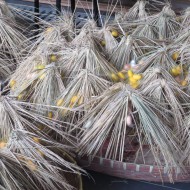
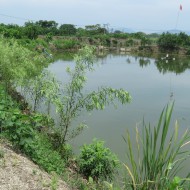
During field visits, participants explored the “Silkworm Fishpond” (Sōki Gyotō), an area known for its freshwater fish farming, with mulberry trees planted along the dikes of the ponds dating back to the Spring and Autumn period. This region practices a cyclical system combining fish farming with sericulture using the cultivated mulberry leaves.
At the executive meeting held after the conference, it was decided that the 5th East Asia World Agricultural Heritage Conference will take place in Tanabe City, Wakayama Prefecture.
2017年07月18日
2017年05月15日
A report meeting was held on the “Current Evaluation of Initiatives Related to Biodiversity Monitoring and Environmental Education in Noto GIAHS,” followed by a workshop with stakeholders to discuss future actions. This investigation, aligned with the revised Noto GIAHS Action Plan from 2016, aims to evaluate biodiversity across the Noto region, develop monitoring methods, and create common educational materials related to Noto GIAHS. OUIK compiled the foundational information in collaboration with Kanazawa University Noto Campus.
The study analyzed the action plans and basic environmental plans of the nine municipalities that constitute Noto GIAHS, as well as biodiversity-related surveys conducted by local governments and the prefecture. It also reviewed the status of educational activities related to biodiversity, such as observation events in local elementary, middle, and high schools. A total of 25 participants attended the workshop, including members of the Noto GIAHS Promotion Council (representatives from the nine municipalities), members of the Noto Biodiversity Research Group, and participants from the Noto GIAHS Utilization Executive Committee.
At the beginning of the meeting, Researcher Iida from OUIK presented an overview of the report. Subsequently, participants were divided into four groups, with OUIK members and faculty from Kanazawa University serving as facilitators to work on developing educational materials for effectively communicating Noto GIAHS to the next generation. Each group presented ideas for stories that could be used as common environmental education materials for Noto GIAHS, focusing on marine products like oysters, sea cucumbers, and seaweed, while illustrating the connections between these elements and forests and rice paddies. Active discussions ensued, and it is expected that these outcomes will lead to ongoing collaborations in 2017 for creating educational materials and developing biodiversity monitoring projects for Noto GIAHS.
2017年05月29日
Operating Unit Ishikawa/Kanazawa (OUIK) conducted its 6th Noto Satoumi Seminar in Wajima City on Feb 16, 2017. Bringing this seminar series to the schools for the first time, Ms. Chiharu Hayase was invited as guest speaker where shared her 30 years of experience working as an Ama-diver (free-diving women fishers) over a talk-show session with OUIK Researcher Ms. Evonne Yiu in front of an audience of 30 students at Monzen Junior High School.

Ms. Hayase explaining her work underwater
Ms Hayase shared that ama-divers are trained from young by learning free-diving techniques from their family members and fellow ama-divers. Ama-divers work on a “buddy system”, whereby one will first search for the catch and point out to her partnering diver who will quickly follow to pick up the catch. This task sharing not only helps conserve their energies to enable them to make more dives, but they could also look out for danger for each other. The fishing season for shellfishes like abalone and horned turban shells last only for about 3 months from June to August, but some ama- divers also brave the cold winter seas to gather seaweeds. The women divers adhere to the rule of the short fishing periods and diving time allowed in the waters as they believe that this will keep the marine resources sustainable. The bountiful seafood caught by the ama-divers are then sold as Wajima specialties at the morning market in Wajima City, where the stalls are run also by women of Wajima. The students were fascinated by Ms. Hayase’ s stories of her encounters in the seas and also learnt that their local fisheries are not only run by male fishers, by also supported by many other women from all walks of life, contributing to the sustainable development of the satoumi in Wajima.

2017年05月29日
Operating Unit Ishikawa/Kanazawa (OUIK) is assessing the urban impact of depopulation on the cultural landscape of Utatsu-Sanroku and Higashiyama-Higashi, preserved districts in Kanazawa. To that end we are conducting collaborative research with Kanazawa City. Initial findings corroborate visual inspection that there has been a gradual increase of empty houses, plots, and parking lots in the area.
Our purpose is to work together with local stakeholders in order to find an ecological and sustainable solution for strengthening the resilience of this area. Ultimately, we wish to preserve its history, daily cultural exchanges, temples, traditional quarters, inward gardens, and water canals in order to re-establish a harmonious balance among buildings, vacant plots, and greenery in the city of Kanazawa for the future.
On May 7th, OUIK members visited Higashiyama 1-Chome with members of the Japanese Institute of Landscape Architecture (JILA) Ishikawa branch. During this visit we were able to directly appreciate the cultural landscape and natural beauty of the principal areas, as well as the degraded parts of the district that need to be reconsidered from an ecological point of view. Testimonies from neighbors about the history of this district revealed their current concerns, especially those related to the increasing number of tourists, the loss of neighborhood identity, and the dominance of empty houses and plots in the area.
OUIK will continue to work on this issue with stakeholders.
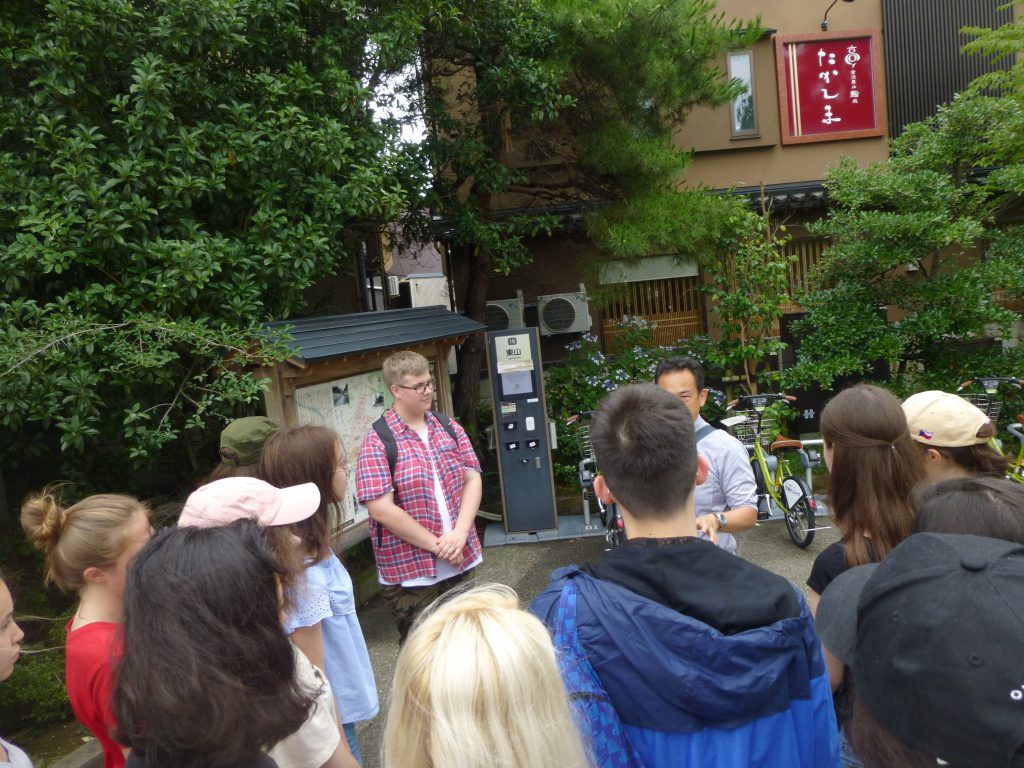
OUIK-ISHIKAWA JILA Visit on May 7th (Image by: Juan Pastor Ivars, OUIK Research Associate)
2017年05月23日
Dr. Yoshihiko Iida, OUIK research associate, participated in the 10th Southeast Asia Biosphere Reserves Network (SeaBRnet) meeting to make key note speech “Roles and challenges of local implementation for UNESCO science program: A case of Japanese BRs”
He contributed by introducing biosphere reserves in Japan as well as jointly implemented project by OUIK and Mount Hakusan BR “Mutual Learning Platform for Asian Local Practitioners of UNESCO’s Man and the Biosphere (MAB) Programme” in 2016 .
He also chaired the session on the coordination of UNESCO science programs including Geopark, International Hydrological Programme (IHP) and World heritage. Detailed report can be refereed from UNESCO Jakarta and Japanese Funds-in-Trust (JFIT)
16-17 May 2017 (Dr. Iida participated session on 16th)
Indonesia, Jakarta
2016年06月12日
Paper by Evonne Yiu, OUIK research associate on comparison of GIAHS in China, Japan and Korea has been published in JOURNAL OF RESOURCES AND ECOLOGY. It is also available from UNU collection.